The life of
Fred Wallis BRUSH
1925-2010
Part 1,
Part 2,
Part 3,
Part 4,
Part 5,
Part 6,
Part 7
Parents Childhood Army Pakenham Radlett Berkhamsted Bourton
Part 1,
Part 2,
Part 3,
Part 4
Parents Childhood Army Pakenham
Part 5,
Part 6,
Part 7
Radlett Berkhamsted Bourton
A full introduction is in Part 1. Except for correcting a handful of clear typos the main text is exactly as Dad wrote it. The footnotes, the photos and the notes beneath them and the text in bordered panels have been added by me.
David Wallis Brush
MARRIED - AND BACK TO SCHOOL
On the ninth of August, nineteen fifty-two, the Marriage Service for Fred Wallis Brush and Edith Marilyn John was conducted by Revd. Ernest Hotchin Wright in Bowes Park Methodist Church. It was a windy and not very pleasant day and for the photographs outside the church, Marilyn's wedding dress had to be anchored to the ground with stones, otherwise anything might have happened. David Brisby, my friend of S.T.C. and the Northern Poly, was Best Man and the two bridesmaids were Ann (Marilyn's step-sister) and Audrey Dell. Some of the guests at the wedding were local, some from Pembrokeshire.
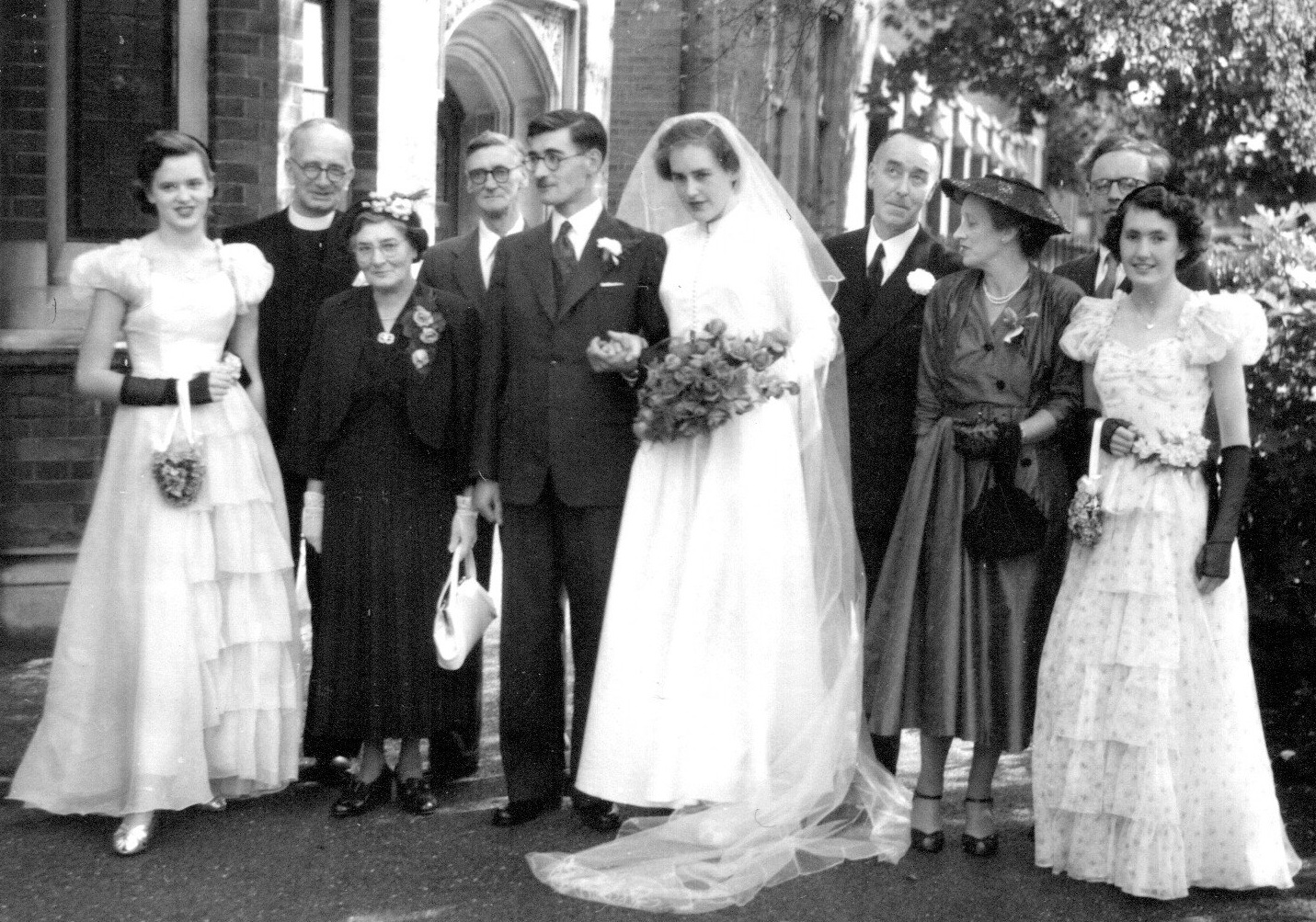
Ardita/Ann (Mum's stepsister),Revd Wright, Dad's Mother, Dad's Uncle George, Dad, Mum, Mum's father and stepmother, David Brisby, Audrey Dell. Dad was 27, Mum just 20.
We spent our rather short honeymoon at Winchcombe. When it was over and we returned to Palmers Green we had to stay at Melbourne Avenue for a few days since we could not yet move to our first home, at Pakenham in Suffolk, about seven miles from Bury St.Edmunds where I was to start teaching. When all the legal business was finished we moved with our wedding presents, the furniture we had bought in anticipation, and various other bits and pieces and settled in at 'Greycot'.
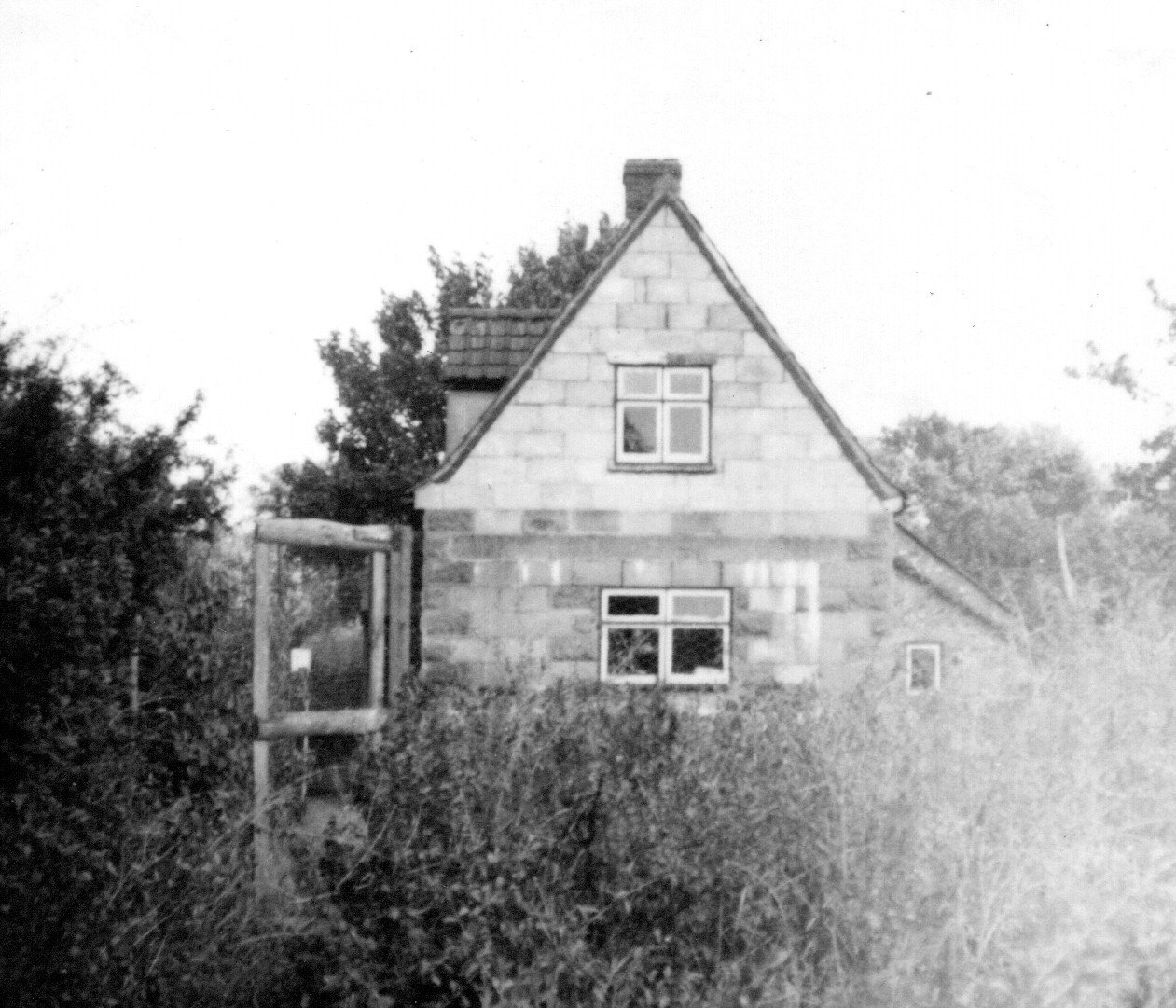
'Greycot' was a small cottage made by joining two even smaller ones together. It was probably three hundred years old, made of a timber framework filled in with what one of the locals called 'pea-sticks and pug' - a mixture of clay, chalk and hair, on sticks tied together and fixed between the beams. Over the seven years we were there we uncovered and cleaned up the beams and plastered the exposed surfaces between them for all the rooms except one. We had two rooms downstairs, a walk-in pantry and a bathroom, and an entrance hall. Joining the two rooms was a kitchen built-on at the rear. Upstairs we had two medium sized bedrooms with sloping ceilings and two small bedrooms, though one of them contained the cold-water tank so it was not very much use. Cooking was on a Rayburn stove; lighting was by calor-gas lamps in the two major rooms and the kitchen and we used candles elsewhere, though we soon bought a Tilley lamp to make life easier. We had a well at the back of the house from which we pumped water to the cold water tank and fortunately the Rayburn provided all the hot water we needed as well as cooking our meals and keeping the kitchen warm. For the two main rooms we had open fireplaces - elsewhere there was no heating.
It was an adventure. Marilyn had to learn to cook on the Rayburn and we had to adapt our life to fit what we had. The water in the well was not as pure as we had hoped but later on both mains water and electricity were available and life changed. We had about an acre of land in a long narrow strip (known locally as a 'spong') parallel to the road with the other side backing on to an open field which the Tipple family farmed, using two Suffolk Punch horses. The Tipples, Charlie and Laurie, were hurdle-makers, their workyard being at the far end of our 'spong' just the other side of the tin tabernacle where an Anglican service was held. Hurdles were made in the traditional way, the timber being cut in the woods and hauled out by the horses - a tractor would not have been usable in the woods.
The lower end of the land was faced on the road side by a brick and flint wall. I grew our vegetables on this lower part and we kept some hens (and later ducks and geese) on the upper part. At least they kept the weeds down although I never managed to cut all the many yards of boundary hedge, mainly young elm-trees. What I did manage to cut down was useful for our open fires, while the coal deliveries of Mr. Peachey provided for the Rayburn.
Pakenham is noteworthy as being the 'village of two mills', a windmill and a watermill. When we lived there both mills were still working, the windmilll providing our poultry meal. Food for livestock was still rationed and I applied for and received ration documents for the hens. I gave these to Mr. Bryant and he provided me with poultry meal and corn, probably far in excess of my lawful allowance. The water-mill was being used to mill cattle food only.
In the village of Pakenham itself (for Greycot was half-way between Pakenham and Ixworth), lived Will Rayner who taught Geography at the County Grammar School. It was arranged that I should cycle to the village and he would give me a lift in his car into School each day. The system worked very well on the whole and this continued all the time we were at Greycot. Using the bus service would have meant a walk to the main road. On Wednesdays and Saturdays there was a bus to Bury St.Edmunds which actually went past our door - but it was only once or twice on either day and timings were not convenient. It was, however, the only way Marilyn could get into town.
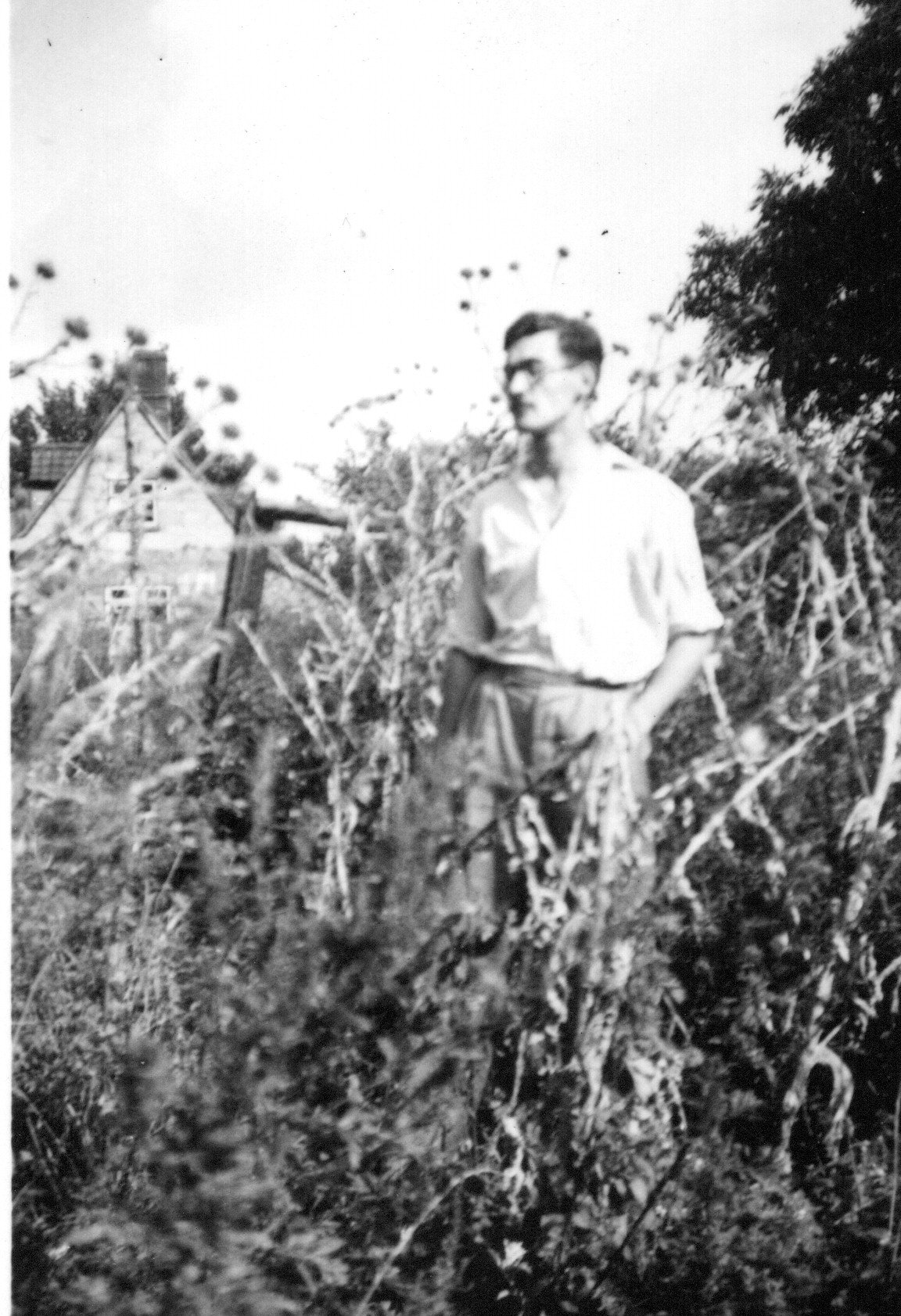
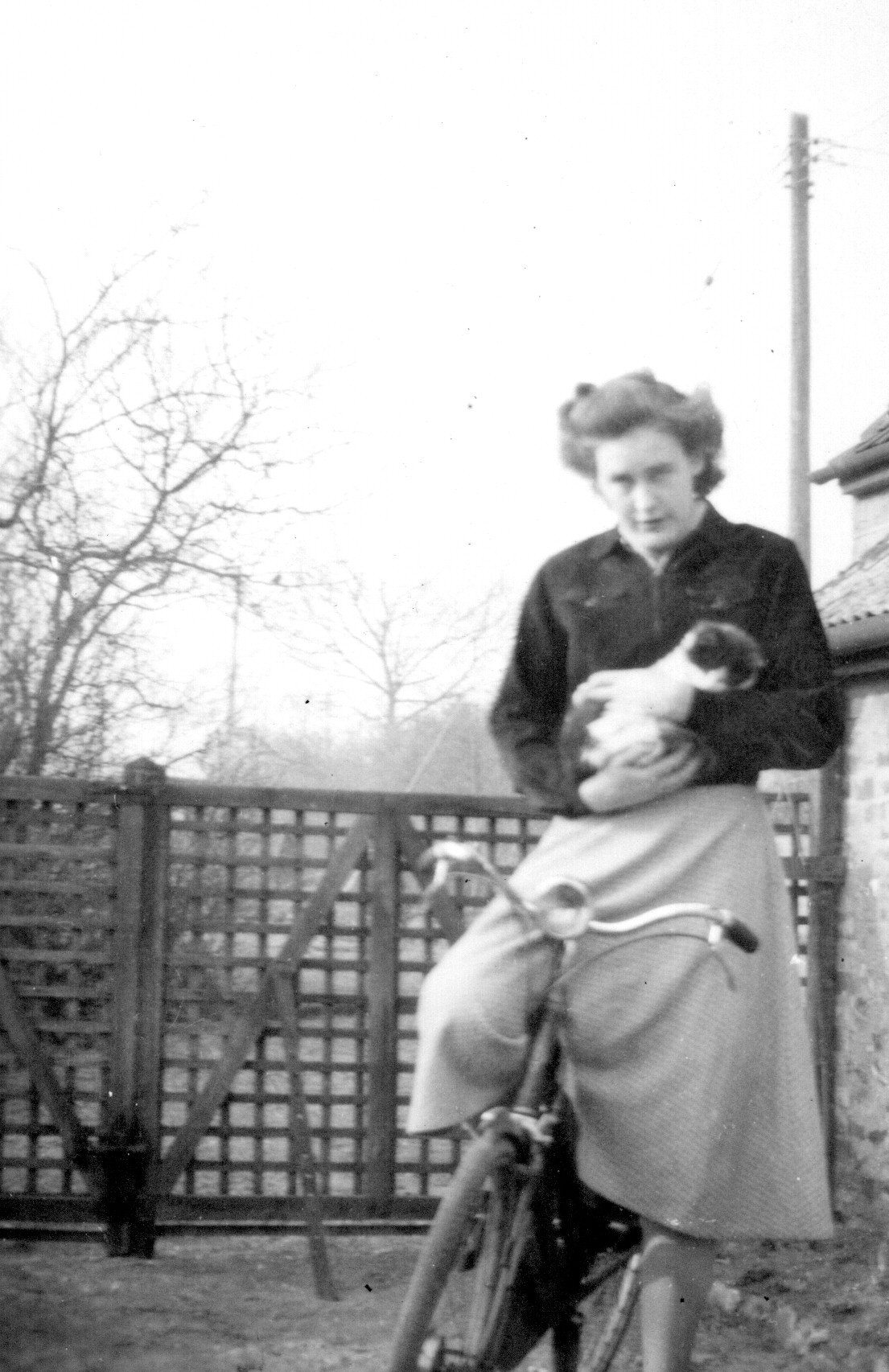
Dad in 1952 and Mum in 1953
Dad in 1952
Mum in 1953
The morning and evening rides along the Fen road between Greycot and Bell House (originally a public house) where Will Rayner lived were generally uneventful though one or two instances remain in the memory. There was a very snowy day when we had to abandon the car before reaching Pakenham and I had to walk to the village, pick up my bicycle and then push it all the way along the Fen road. There was another happier time when halfway along the Fen I was attracted by a bright green light in the hedge - a glow-worm, the first I had ever seen. There were other things too - in sunshine after rain on ploughed land the sight of a rat actually dancing in the furrows. At the lower end of our land the road forked and went over a little bridge - known as Baileypool - and at first the little house by the bridge was not inhabited. In the trees around nightingales sang until the house was once again put into use and we heard them no more.
Marilyn was able to join the Women's Institute in the village and also a group that met at Ixworth. I was one of the founder-members of the Horticultural Society and became its Treasurer. Gambling on fine weather and massive support we held the first Flower Show on August Bank Holiday Monday.
The Committee tent had been well-stocked with a supply of brown ale and by the time came for the show to be officially opened by the visiting celebrity neither the Chairman nor the Secretary were in a state to undertake the introduction and it was with some horror that I was given the job - I had no idea who the visiting celebrity was. Still, I managed something vague and the show was officially open. In my treasurer's capacity I spent the afternoon rushing around collecting money from the side-shows and putting it into little envelopes for the prizes as fast as I could. When things quietened down a little I discovered that my entry of sweet peas had received 'best in show' - surprising since I was up against commercial and experienced growers. Perhaps the judges had been helping to sample the brown ale in the Committee tent. Against all the odds the venture succeeded and the Society had a welcome profit.
Just down the road around' the corner was a cluster of houses known as Grimstone End. The little Methodist chapel was there, with 'EBENEZER" carved on the front. At least, it had been carved on the front but some time before we went the front had fallen down The chapel was in a poor state of repair and I am not surprised that it has now been demolished. Billy Peck was the Steward and the congregation usually consisted of his mother, his uncle, his sister, his brother-in-law amd us.
Also at Grimstone End was Mrs. Peck's shop (the name Peck was found all over the village and district - and those with that name might or might not be related). It was really a room in the house and Mrs.Peck either had what we wanted or had something just as good. It was in Mrs.Peck's shop that David carefully surveyed the recently-arrived village constable and announced loudly "That's a very fat policeman !". True but tactless, because the previous constable had been very tall and thin and had developed a habit of dropping in for a chat from time to time, obviously expecting a cup of tea. The village had two or three shops as well, one being the post office and newsagent. Arthur Bantick was the postman - frequently slow on his rounds so that (between ourselves) we referred to him as 'the late Mr. Bantick'. As is usual in the country we always used the back door but Arthur would never do this. If he had a parcel to deliver he would leave it in the front porch where we might find it after a day or two if we thought to look.
Sometimes there were unexpected things. Near the hurdle-yard there was a ruined cottage used by the emergency services for practice (could it be that the wartime A.R.P. was still in existence then ?). Marilyn was inveigled into acting as the casualty on one occasion and while passing her stretcher-fastened form through a window the rescue party paused for photographs. Marilyn was the only one NOT protected by a steel helmet from probable falling masonry !
Marilyn had all the trouble of housekeeping - and the isolation - while I went off each morning to Bury. The school was a County Grammar School of two-stream entry but it was running down with the aim of becoming a single-sex girls school within two or three years. This meant that a class might consist of twenty-five girls and five boys.
I had been appointed as Head of Science. At the same time Don Woodhouse was appointed to teach Physics and there was a Biology teacher who had been there for some years. She was somewhat annoyed that I had been brought in 'over her head' as it were and it took some time before the initial coldness wore off. Fortunately it was nothing worse.
There was one large laboratory and a very small room used as a store and for small groups of sixth-form teaching. and these were shared by Don Woodhouse and myself. Fortunately there was a separate Biology lab otherwise there would have been three of us trying to fit in. The larger lab was terrible. The benches had been obtained second-hand, I was told, and were scarred and furrowed from long misuse. The windows were iron-framed and had been painted so often that they would not close properly and in my first winter there it was unbearably cold. I asked the caretaker to do something about it - he forced them shut so that when spring came we couldn't open them again. The heating system was contained in cupboards along two walls, with metal grills through which the heat came from the water-pipes and it was on these heated surfaces that we had to stand our elderly beam-balances. Attempts at accurate weighing were a farce. Fortunately in the little room there was a stone bench so that the sixth-form work had more chance of accuracy.
W.J.Fawkes, the Headmaster, had been Senior Master and was holding the fort until the impending changeover, when he proposed to retire. I had the impression that the job of Head was a litle beyond his ability with the result that he was fussy about trivialities and did not give a real lead. When I met him after he had retired he was much more pleasant and relaxed. The Senior Master, John Bridges, was very helpful to me, not only in what he said but more in the example he gave to Don and myself who were in our first teaching posts. I was often glad in later years to think back to the way John Bridges would have acted. He was very fond of church music and was organist at the well-known church at Lavenham.
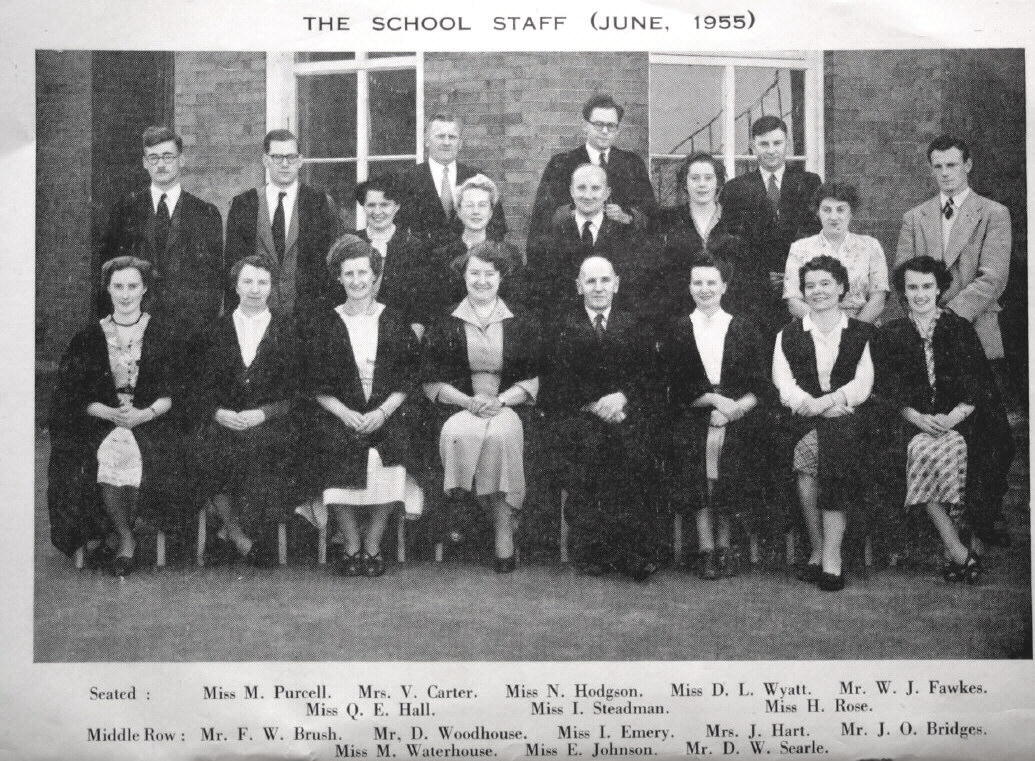
The staff of The County Grammar School in 1955.
In the event, I was at the County Grammar School for three years. I well remember the final Assembly in July 1955 forwork had already started at the rear of the school to clear the site for some new buildings. In the middle of the Assembly we heard the crash as the great beech tree was felled - it signified the end. In September I moved to the King Edward VI School in Bury, together with the rest of the male staff and the handful of boys that was left. Another chapter of my life had started.
But while this side of my life was going on we had increased the family. David was born in the West Suffolk General Hospital on 31st July 1954. In those days fathers did not attend births and having seen Marilyn off in the ambulance I had the news of our son by telephone. It was a great moment.
THE KING EDWARD VI SCHOOL
In September 1955 I started at the King Edward VI School. To some extent the routine was the same, for Will Rayner had moved with me after the County Grammar School closed and I still had a lift daily to and from Bury. As the name implies, the school had a long history but was now being modernised and enlarged. On our arrival we found that a large new building had been put up, with spacious rooms for a Physics lab on the ground floor, a Chemistry lab on the first floor and a large Geography room on the second floor. There were also class- rooms and a staff-room. The existing Chemistry lab was now given over to sixth-form Chemistry.
.jpeg)
This image was supplied by a former pupil at King Edward VI who said, of Dad, "His Chemistry Laboratory was located in Edwardian buildings c.1910 on the Vinefields Site. I attach a photo taken rather earlier but with somewhat similar character! I recall that, peering through the windows of his Lab, he had some excellent pencil drawings by one of the senior pupils displayed above the blackboard so I assumed that he had a liking for artistic work."
The school had a few boarders, mostly sons of service families serving abroad, but most were day-boys, but 'Bob' Elliott the Headmaster persisted in regarding the boarders as the 'main' part of the school, the day-boys being almost present by accident - a harmless foible, fortunately.
Obviously the staff was made up of old and new faces. John Bridges was no longer Senior Master since 'Duggie' Young already held that post. I was no longer Head of Science, the post already being filled though it made little difference in practice - I taught most of the Chemistry. The Biology was taught by Elsa Kilpatrick, an eccentric lady who conducted lessons with her dog at her feet and (from time to time) came into the Staff room with a white rat on her shoulder. She saw no reason why, being female, she should be treated differently from the men and insisted on being addressed as 'Sir' by the boys.
There were other differences too. We now had Saturday morning school which was a nuisance. Often Will Rayner had engagements or was staying in town and I had to come back to Pakenham by bus and this meant that most of the afternoon was over by the time I had my mid-day meal (very rarely at mid-day !). In theory this was compensated for by Wednesday afternoon being free of lessons but it soon became obvious that this time was to be used for games, Cadet corps or clubs such as the chess club. School Dinner was served in a pre-fab building and the Master on Dinner Duty had to say Grace in Latin before and after the meal. "Benedictus benedicat... Benedicamus benedicatur". Founders Day meant a procession in full academic dress through the Abbey Gardens to the Cathedral where a service was held. Morning Assembly also was more of an Anglican service with the boys reciting the Creed and other parts of the Prayer Book. On one occasion a boy fainted at Assembly and was carried out by two Masters - Bob Elliott didn't even pause in his prayer.."..and even now, while we are placed in the midst of things which are passing away, let us cleave to those which abide..".
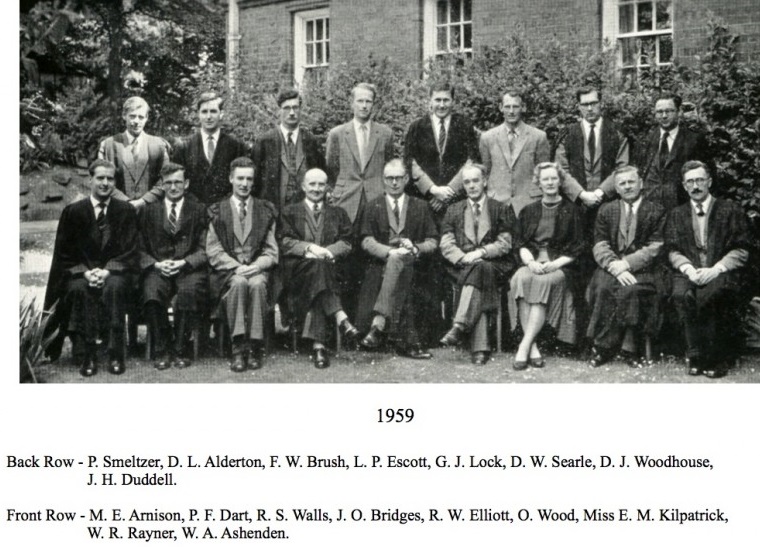
The staff of King Edward VI in 1959, including Dad, Miss Kilpatrick 'sir' and others mentioned by Dad. Gowns will be worn.
At home, David was toddling about. His play-pen was no problem indoors but when it was put on the 'lawn' in the garden he soon discovered he could push it about and travel taking his play-pen with him. We had to anchor it on the grass with iron spikes. Earlier we had acquired a cat originally named Susanna but after we discovered she was he we re-christened it Hadrian (because he spent a lot of time on the wall, of course). He was not a friendly cat but would tolerate David pulling him about, much to our surprise. Hadrian went off for a day or two from time to time - on what errand we could only guess - and from one of these excursions he never returned.
In 1958 Hilary was born, on the 27th of July. There was some anxiety over the fact that she was born with a tooth and that she developed a localised infection but a longer than usual stay in hospital solved both these problems although she had to put up with a crooked front tooth until she got her permanent adult set.
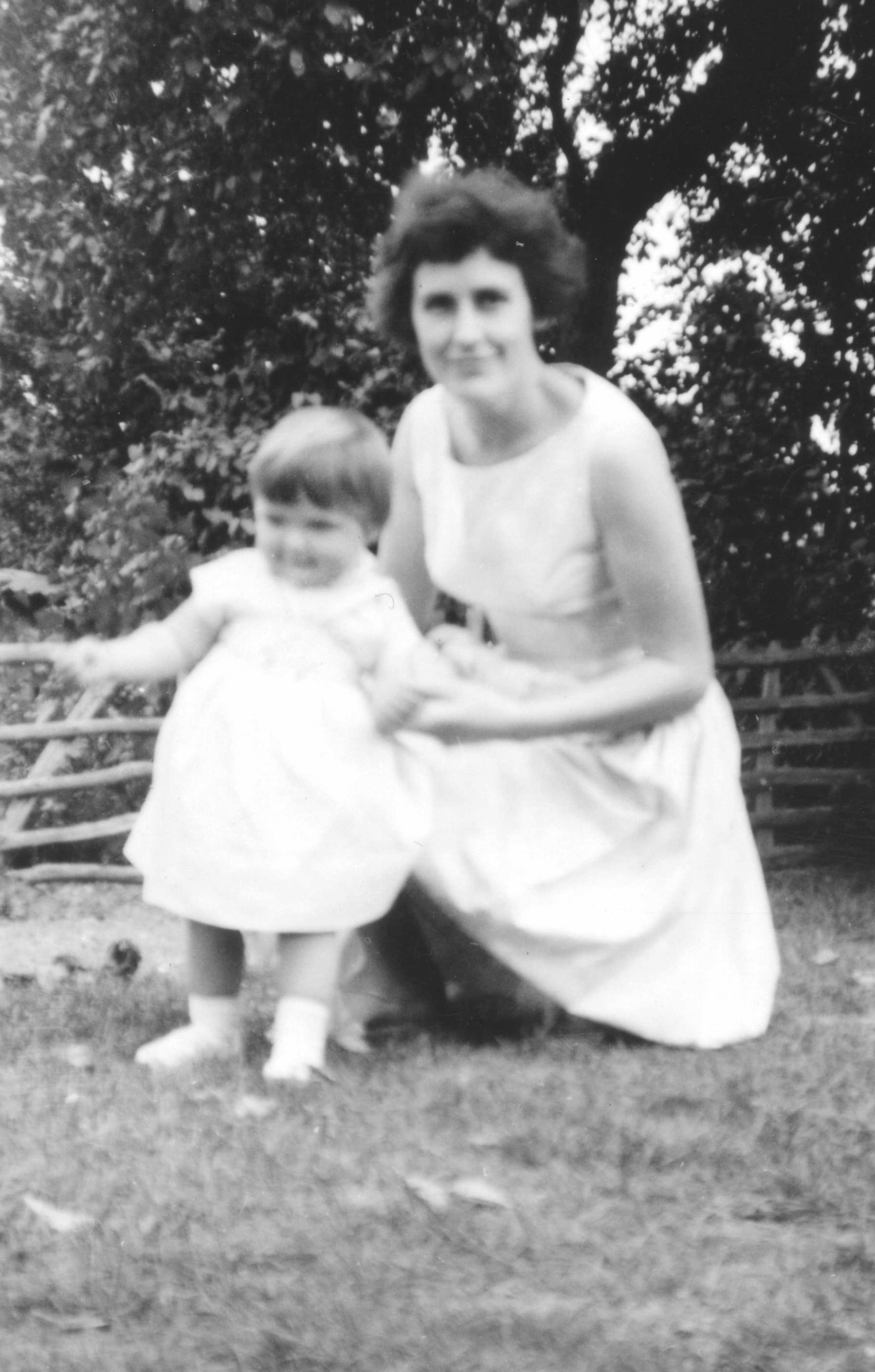
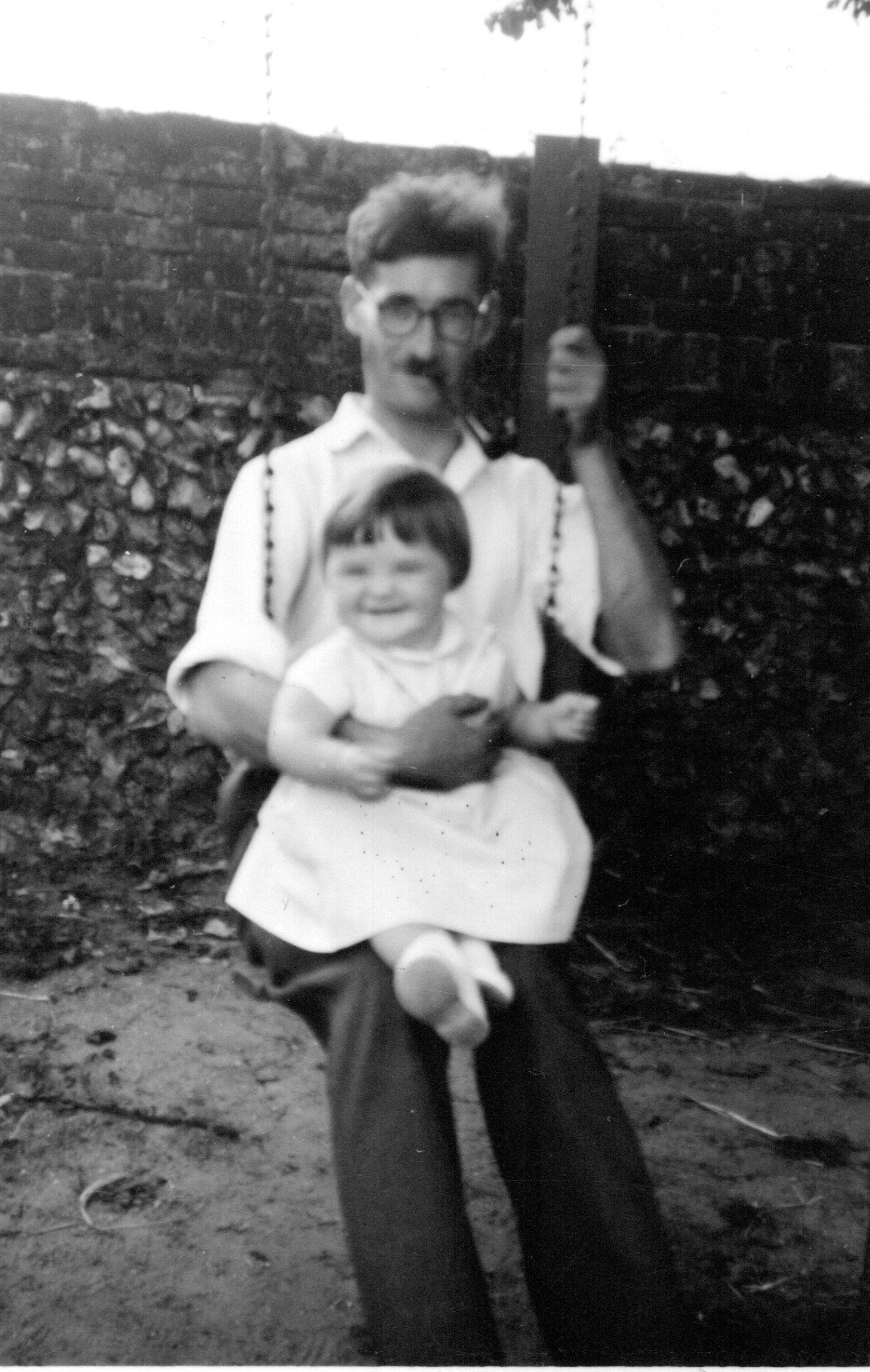
Hilary at Greycot 1959
1958 was also noteworthy because I bought our first car and Marilyn and I took driving lessons. It was easy to pass the driving test in Bury in those days (for example, there was only one set of traffic lights) and we both passed at the first attempt. This gave us a freedom of movement we had not had hitherto. The car was a Ford 'Popular', Bristol Fawn (a kind of grey) in colour. It served us well for years and we took it abroad some years later for our first holiday on the continent when we did a tour of Belgium.
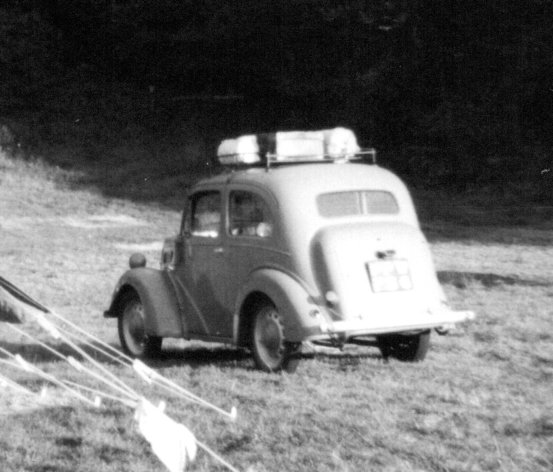
PPW 756, seen in 1961 on a camping holiday
In 1959 David was five years old. He had been to a little local nursery school for a short while but we had to consider the future, not only of David but of all of us. If we stayed in Pakenham it would mean that he (and later, Hilary) would attend the village school and in the course of time David would go to the school where I was teaching and we did not think this would be a good thing. (As it happened, a somewhat similar situation arose with Hilary much later on). In addition, my mother was causing some concern and we decided we would try to move closer to her at Palmers Green to be reasonably near in case of emergency. I started looking for possible teaching posts and in the autumn of 1959 I started at my final school in Bushey. Marilyn and the children had to stay a little longer while the house was sold and our new home bought in Radlett and for a while I stayed with Mrs. Jack in Aldenham Avenue in Radlett, driving home on Friday evenings and returning to Radlett on Sunday evening.
Meanwhile, David started at the village school and Marilyn had to cope with a walk along the Fen road into the village every day. Eventually the legal requirements were settled and we were united again.
Continued in Part 5
Part 1,
Part 2,
Part 3,
Part 4,
Part 5,
Part 6,
Part 7
Parents Childhood Army Pakenham Radlett Berkhamsted Bourton
Part 1,
Part 2,
Part 3,
Part 4
Parents Childhood Army Pakenham
Part 5,
Part 6,
Part 7
Radlett Berkhamsted Bourton