The life of
Fred Wallis BRUSH
1925-2010
Part 1,
Part 2,
Part 3,
Part 4,
Part 5,
Part 6,
Part 7
Parents Childhood Army Pakenham Radlett Berkhamsted Bourton
Part 1,
Part 2,
Part 3,
Part 4
Parents Childhood Army Pakenham
Part 5,
Part 6,
Part 7
Radlett Berkhamsted Bourton
Part 1 : Introduction and Family Background
Sometime around the year 2000 my father Fred Wallis BRUSH, "of happy memory"(1), wrote his autobiography for his grandchildren. He was too modest to call it his autobiography….

"I have decided to write this personal account, not presuming to call it an autobiography."
….but that was what it was. Or we can call it his memoirs. All 51 pages typed on his trusty portable Olivetti Lettera 32 typewriter.
He dedicated it to his, then, four grandchildren and then sometime after 2003, in his increasingly spidery hand, changed it to five to include Henry. He died before his sixth (and final) grandchild Laura was born. But he knew she was on the way and that pleased him greatly.
I have taken the liberty of adding to it but, except for correcting a handful of clear typos, have left the text exactly as it was. He did not include everything he could have done and it was not illustrated though he marked it 'Illus' in several places where he thought something should be added. Difficult on a typewriter! The footnotes, the photos and the notes beneath them, the text in bordered panels and a few small notes in italics have been added by me. I hope he will excuse, and maybe appreciate, the tinkering.
David Wallis Brush
FOREWORD
To the Splendid Six(2): Oliver, Nicola, Matthew, Lizzie, Henry and Laura:
How little we know of our family history. Memories are full of faces and names of people from the past and years later we have no idea where they stand in the extended family - but were they family or just friends? You may hear names spoken about but you will have no idea who they are. After much persuasion(3) I have decided to write this personal account, not presuming to call it an autobiography, in the hope that it will answer some of the questions you are bound to ask sooner or later.
Where do I start? If I start just with myself there will be mention of relatives in previous generations and they will need footnotes and explanations. Perhaps I had better go further back to my grandfathers (for there were two of them, and I knew neither).
An outline family history of the Brushes exists already, but it is little more than an outline(4). We know a little about some of the people who appear in those pages, starting (we think) with Richard Brush of Tewkesbury(5) and finishing with yourselves, but the great majority of them are merely names with (we hope) accurate dates of birth and death. In this account I hope to cover a much more restricted field - probably the last one hundred and fifty years- but to provide much more personal information.
It will also give an account of my life - or at least that part of it which is already 'history'. I cannot claim that my life has been anything special nor is it particularly important - for most of the time it has been singularly uninteresting - but it does at least give some idea of what I have done (or not done). Whether it succeeds or not, it will give some idea of your grandfather and of your family. Who knows, perhaps in days to come you will be asked by your children 'Who was he?' and you will be able to give them an answer.
'Grandad Fred'
EVERYBODY HAS GRANDPARENTS
Everybody has two grandfathers and two grandmothers, even if we do not know them - and I only knew one out of the four. My paternal grandfather (that means, the father of my father) was Arthur Wallis Brush, born in London three days after Christmas Day 1855 in a house very near to where Victoria Station now stands. (If you want to link this with your history lessons, Queen Victoria was on the throne at that time and the Crimean War was still being fought). Unfortunately the actual house he was born in is no more since it appears to have been pulled down to make way for the Victoria Coach Station. Little Arthur's father was John Thomas Brush, a carpenter, and his mother was Mary Ann; and he had two brothers, John Edward and George Samuel and two sisters, Mary Ann and Alice Sarah. Of the five children George was the only one I knew and of course he was old when I knew him.
On the thirteenth of July 1864 John was working at a house at Halliford, a village on the River Thames near to Staines. After work he felt that a swim in the cool river would refresh him but unfortunately he got out of his depth and drowned. You can imagine how his wife felt, left with no husband and five small children, the youngest only four months old. I think she had a small shop for a time but in 1865 she married James Henry Cooper, another carpenter and they had two more children, named Charles and Charlotte. Charles joined the Army and fought in the Boer War in South Africa, being promoted to Serjeant.
What happened to my grandfather and his siblings after that I do not know. Certainly his elder brother John became a, carpenter and there is every reason to think that Arthur and George worked for a grocer , learning the trade.(6)
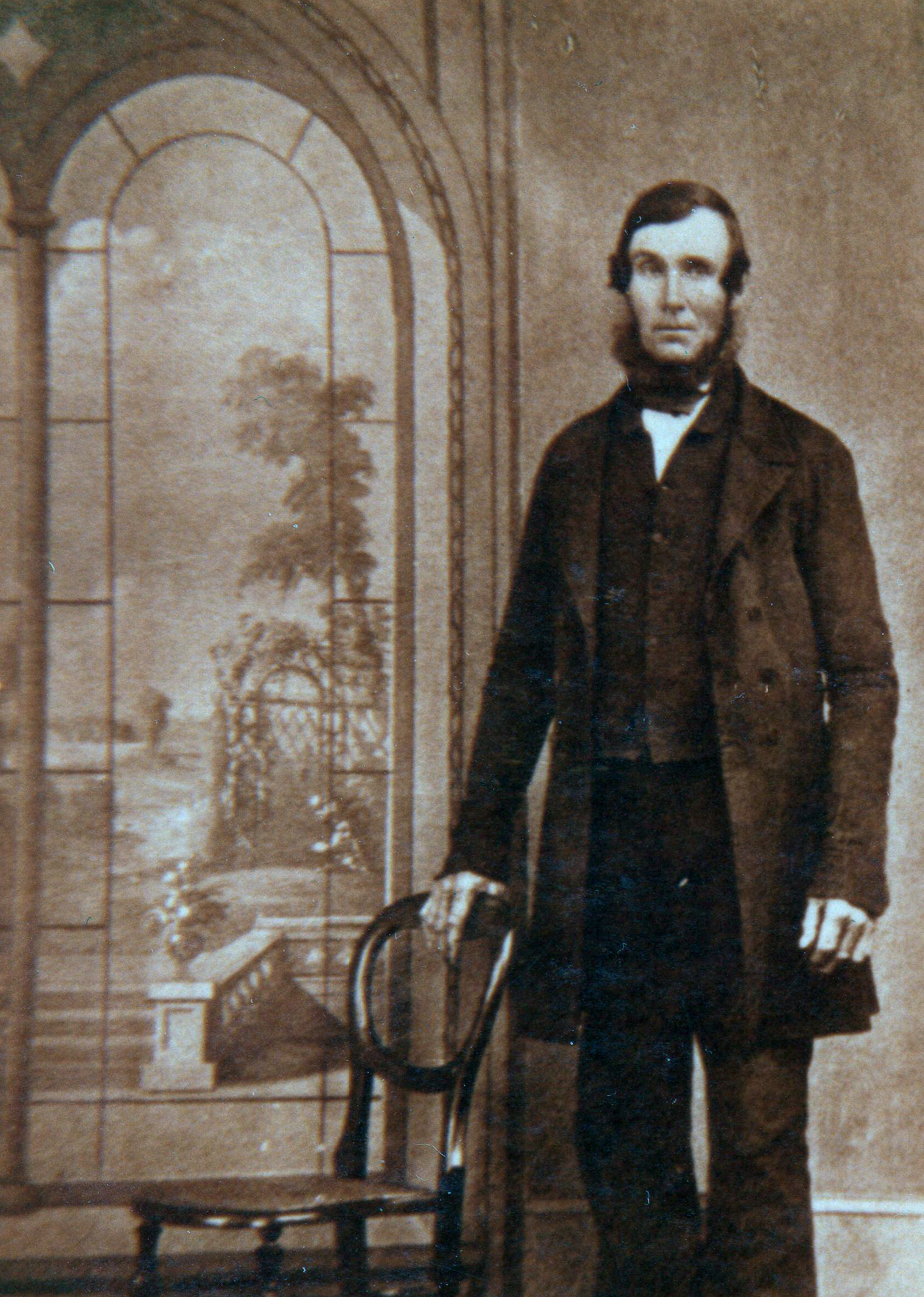
We do know that Arthur met a girl from Cornwall, and on the twenty-seventh of December 1882 they were married in her parish church at Probus, a village near Truro. Emily was the seventh child of John Pleming, a farmer who owned fifteen acres of land. There were four more children after Emily but even so John and his wife Phillippa could afford to send her to London to train as a teacher at Southlands Training College.
John Plemming
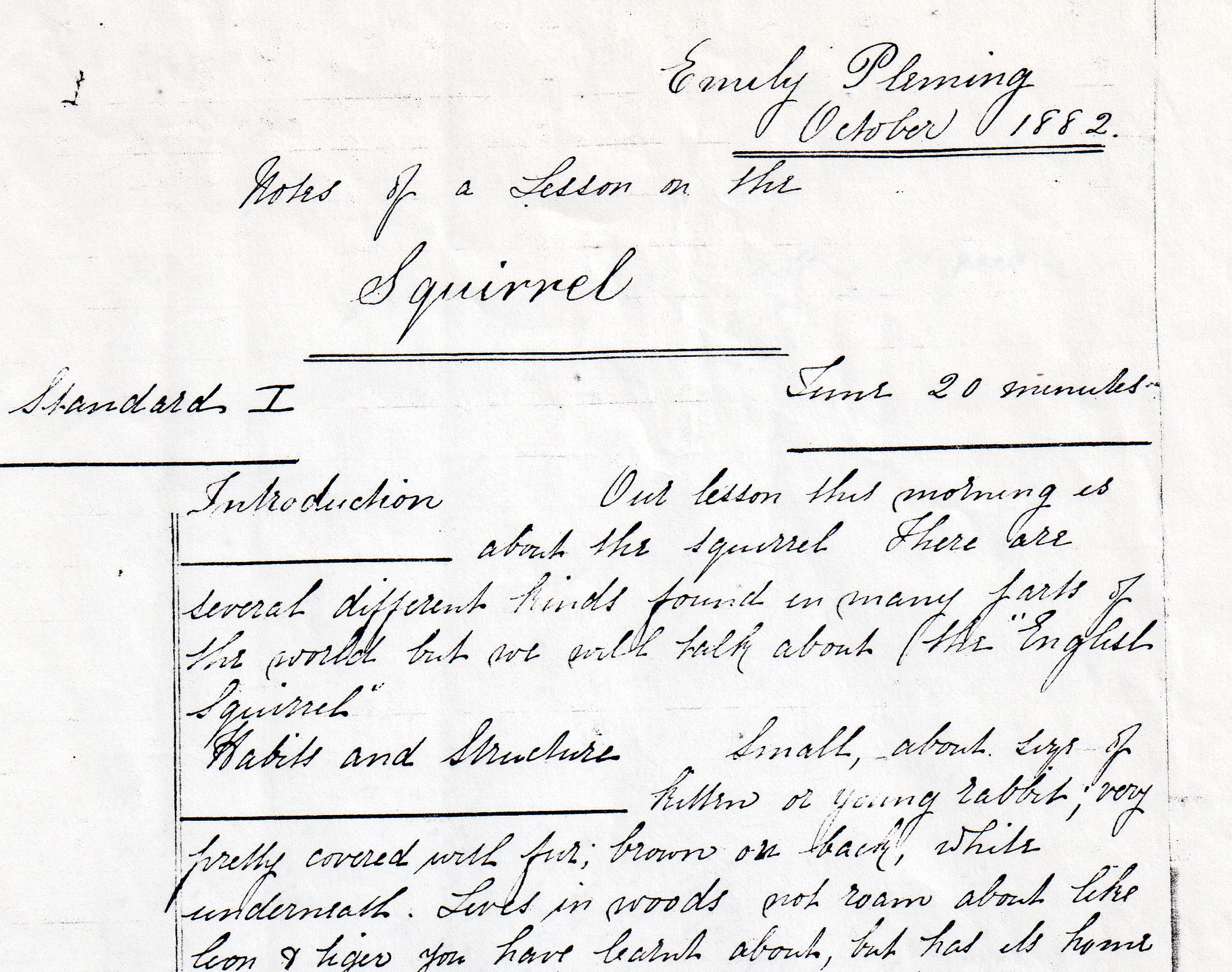
One of the few 'artifacts' in the family records of this period is a photocopy of 6 pages of neatly handwritten lesson notes prepared by Emily in October 1882 shortly before her marriage. Notes of a lesson on the Squirrel, on Different Modes of Catching Fish and of a Reading lesson.
When she married Arthur, Emily was twenty-four and Arthur was twenty-seven. In those days married women were not allowed to be teachers and so Emily had to give up her post. Arthur had by this time bought or rented a little shop at 190a Holloway Road, Highbury, and it was there on 6th November 1884 that their first child was born and christened Arthur Wesley - he was my father and so he was your great-grandfather. 3 other children were born at Holloway Road, Elsie Louise, George Douglas and Herbert Stanley.
In the summer of 1895 the family moved to another shop, this time at Tottenham Lane in Hornsey. Eventually they moved to 'The Shrubbery' in Gordon Road, Hornsey - now no longer there since it was demolished and the whole area redeveloped many years later. I remember going often to 'The Shrubbery' to visit my Grandmother Emily for she lived there until her death in 1938. Grandfather Arthur had died in 1922, just a month after my parents were married, so I never knew him and he never saw me!(6)
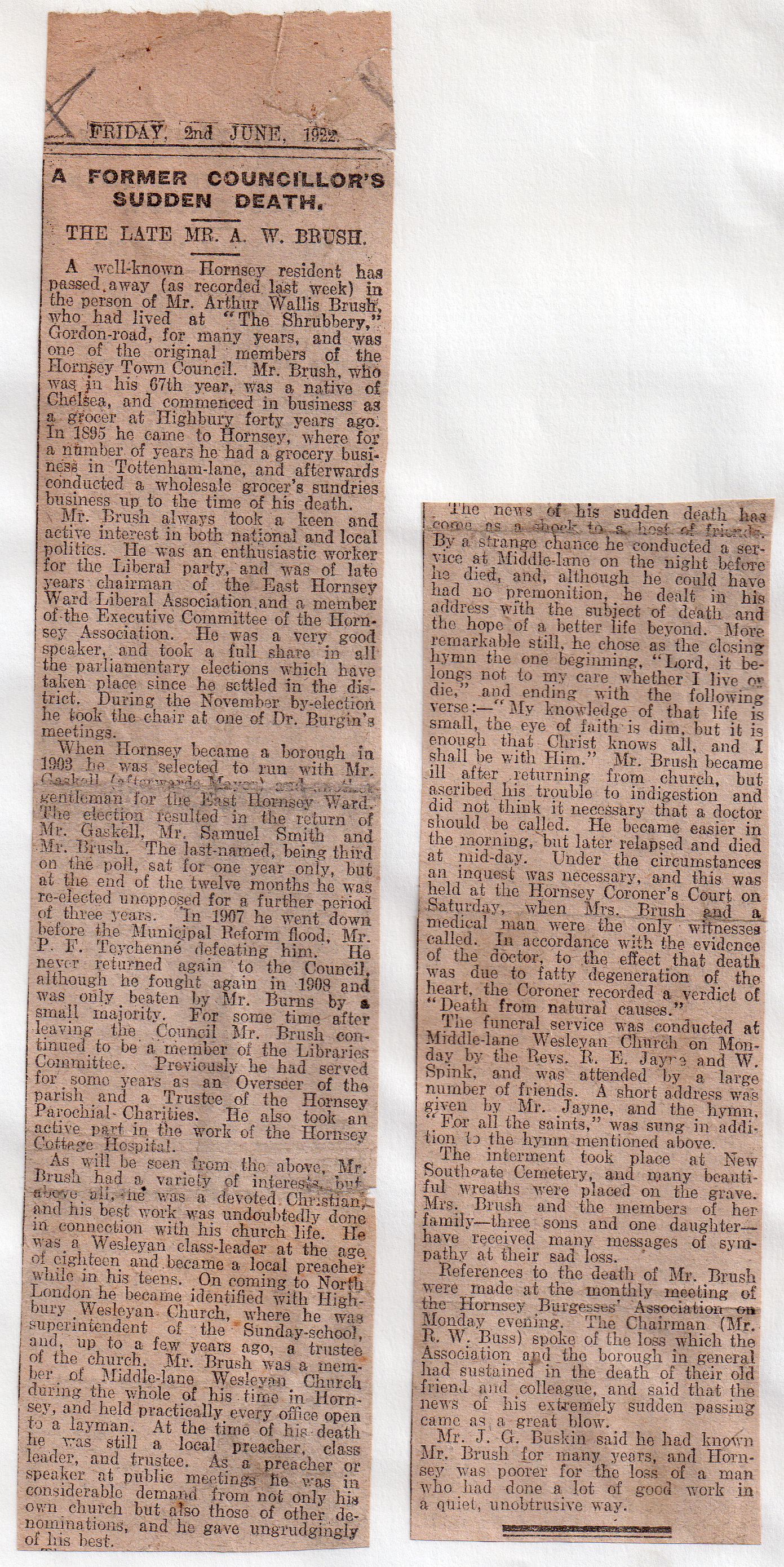 Obituary of Arthur Wallis Brush 1922 in his local paper
About my maternal grandparents (that's the grandparents on my mother's side) I know very little. Thomas Webb was a house-painter in Coventry and he and his wife Sarah Helen had two children; Laura Nellie (my mother) and William John Burnal, known just as 'Burnal', who was the father of my cousin Joy.
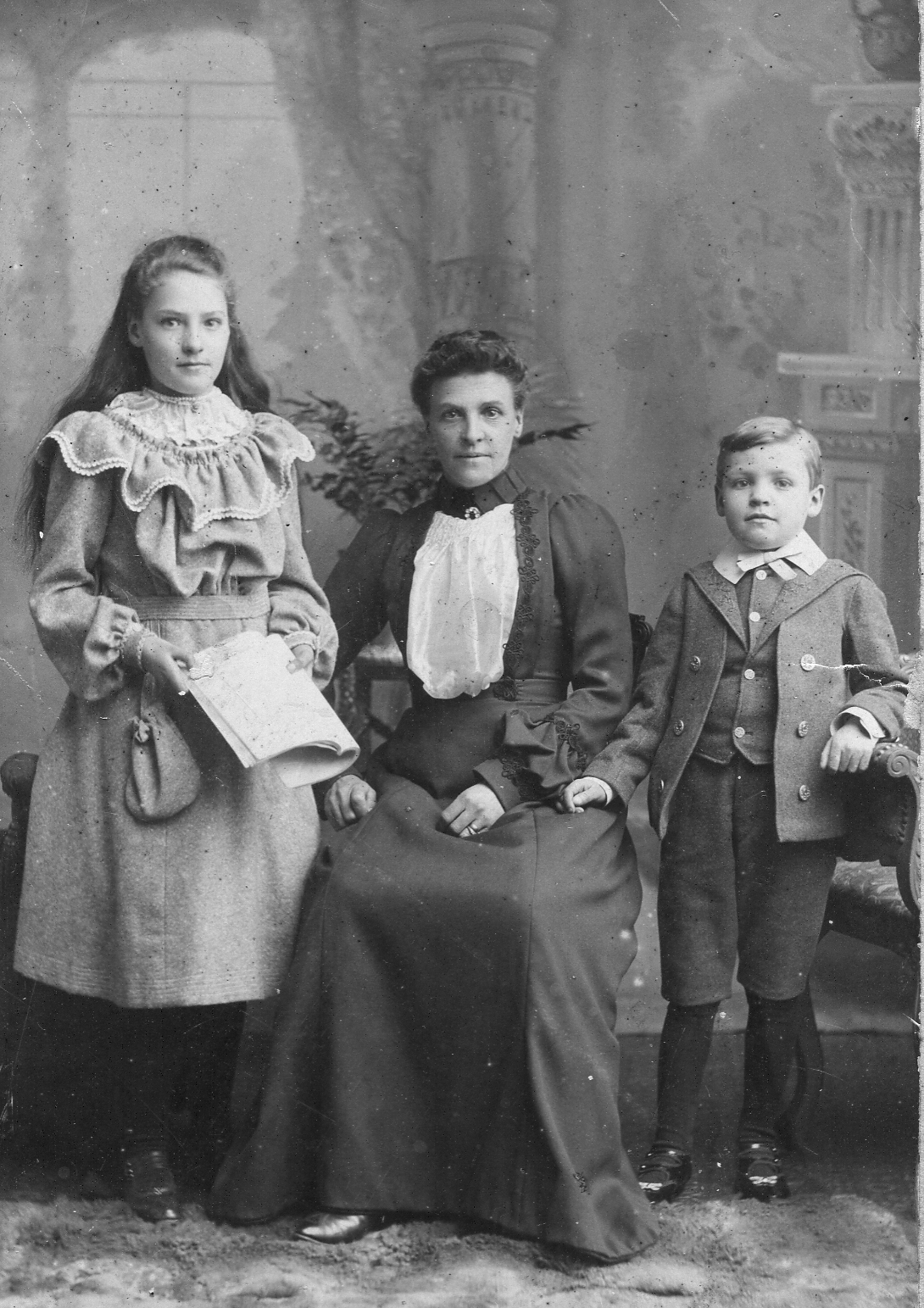 Laura Nellie Webb ( your great grandmother) and Burnal Webb with their mother Sarah Helen (originally Freeman) sometime around 1908 at a studio in Coventry
Laura Nellie Webb ( your great grandmother) and Burnal Webb with their mother Sarah Helen (originally Freeman) sometime around 1908 at a studio in Coventry
Burnal and his wife and daughter were members of the Salvation Army and moved about the country frequently so we did not see them often and indeed it is still difficult to catch Joy as she travels all over the world. She retired from full-time work in 1998. She is a Major in the Salvation Army and at one time formed a group known as 'The Joystrings' .
Thomas seems to have left his family but I do not know the circumstances and Sarah had to provide for herself and the two children so she worked as a silk weaver. Laura was adopted by Fred William Elson, a baker and corn merchant of Berkswell in Warwickshire, and was treated in every way as a daughter so I had an 'extra' grandfather and grandmother in Fred Elson and his wife Mary Jane. However, we never addressed them as grandparents, they were always Uncle Fred and Auntie Mary. My real grandmother Sarah died in 1928 when I was three years old but I was too young to remember ever having known her. What happened to Thomas I have yet to discover.(7)
So there you have the situation as it was when I was a child. My Brush grandfather and my Webb grandmother were dead; my Webb grandfather had disappeared; my Brush grandmother, white-haired and of strong personality, lived alone in a large house in Hornsey refusing to listen to any other proposal for her old age and my 'adoptive' Elson grand- parents had a little farm in Warwickshire, about seven miles from Coventry.
I mentioned my great-uncle George. He became a lay missioner and spent a lot of his life in the North of England. On retirement he and his wife Maud went to live at Bedmond, near King's Langley in Hertfordshire and I remember visiting them there before the 1939-1945 war. Later still they moved to Leigh-on-Sea in Essex and I visited them there too. George died in 1951 and Maud in 1952 - they had one daughter, but she died at the age of twelve in 1911, long before I was born.
MY PARENTS AND OTHERS
My father, Arthur Wesley Brush (known as 'Wesley'), was born in Holloway Road, Highbury on 6 November 1884. He claimed that he could be counted as a true Cockney because (so he said) he could hear Bow bells from Holloway Road, though I think this is very much a case of wishful thinking. In no other particular could he be accused of 'cockneyism'.
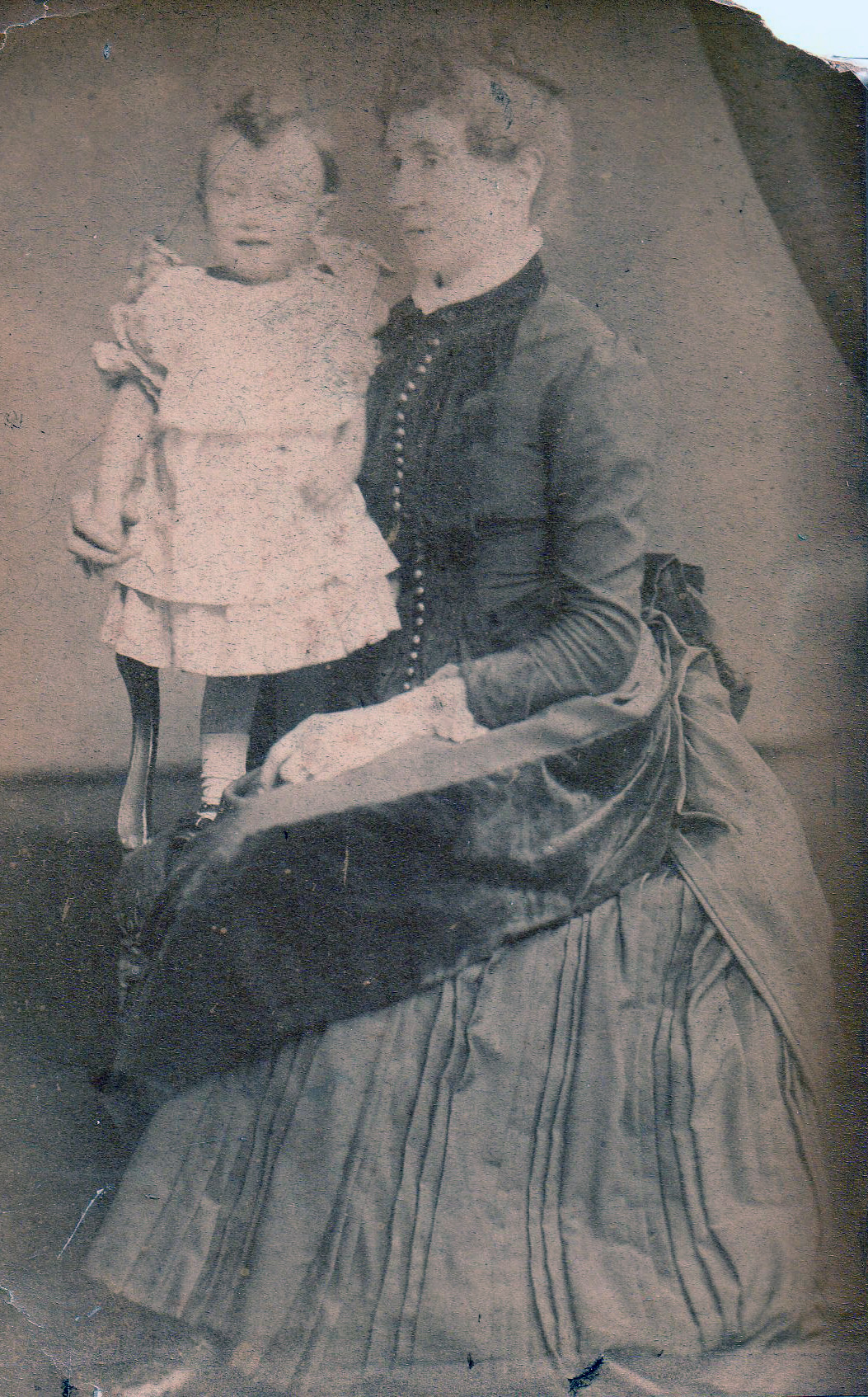
The earliest photo of Arthur Wesley, on the knee of his mother Emily - 1885 or 1886
{He went to school at 'Highbury Wes and Crouch End Sc'.} (9)
It seems that it had always been taken for granted that he, as the eldest son, would continue his father's grocery business. Certainly up to the outbreak of the Great War in 1914 he was employed in it and the business seems to have changed gradually with increasing trade in the importation of spices , coconut and tea (which my grandfather blended himself or different tastes). They also manufactured proprietary items such as 'Gravy Salt' and 'Gravythick' and traded then as A.W.Brush and Sons at Castle Works, Hornsey, though I do not know where the 'works' were situated; it may well have been at 'The Shrubbery' for I remember there were several outbuildings and store rooms as well as the house.
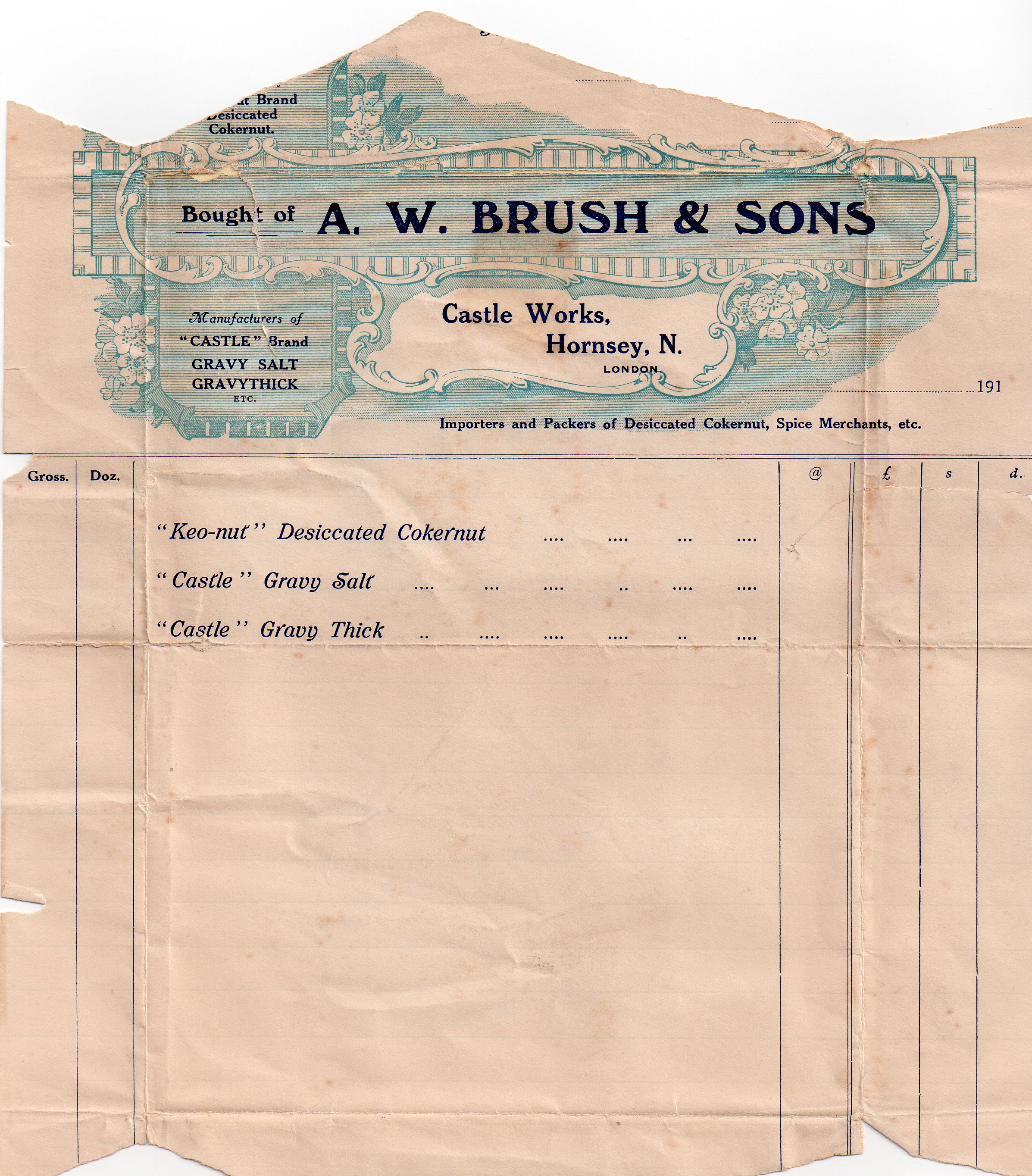 The only remaining evidence of the family business
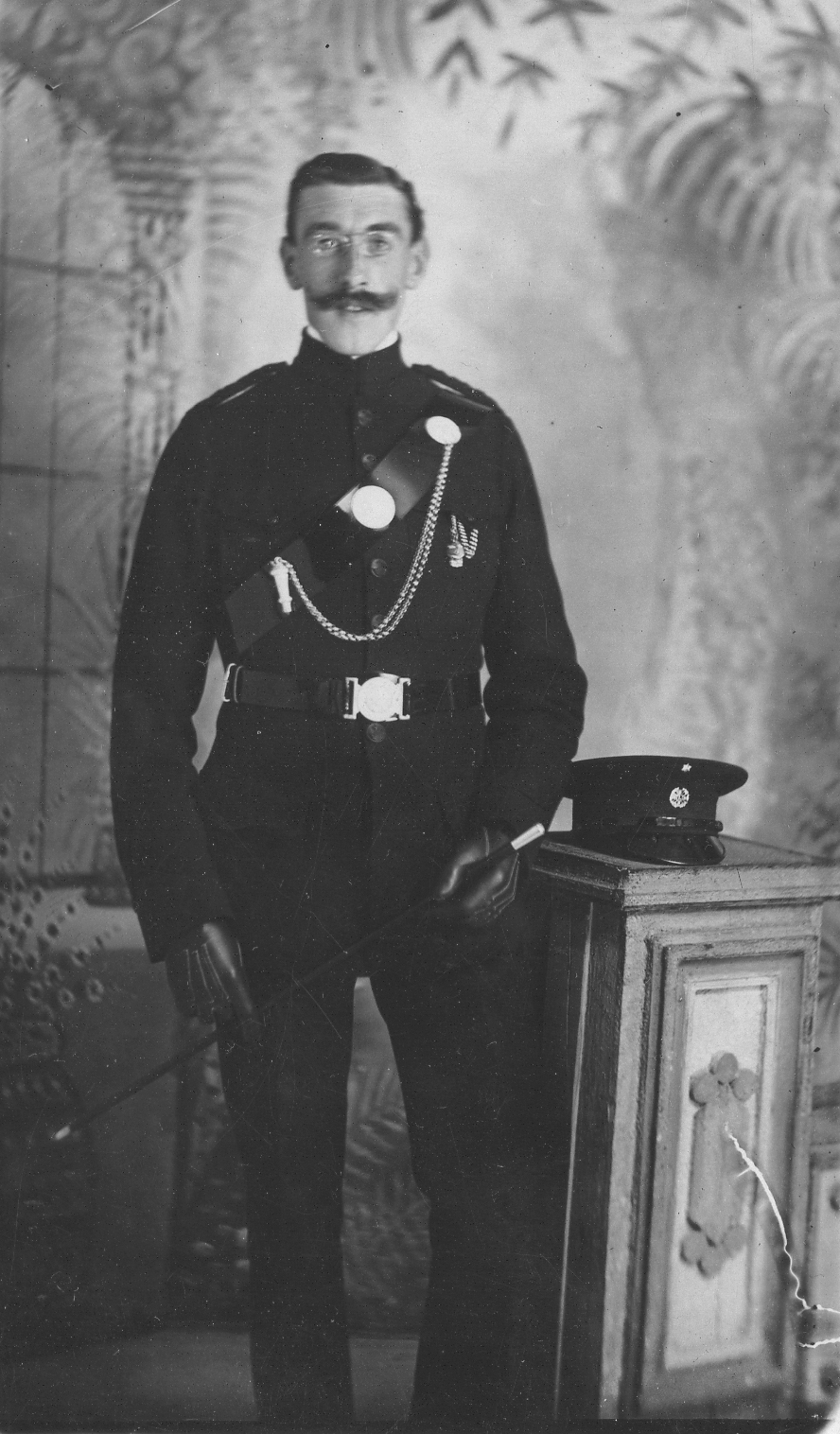
The family was very much concerned with Middle Lane Methodist Church, my father being a Local Preacher(8), an officer in the Boys' Life Brigade (which later became part of the Boys' Brigade) and a teacher in the Sunday School. At one time he considered emigrating to Canada to become a minister of the church but decided to stay in England. (Remember that in those days travelling to Canada meant a long sea voyage - there was no air service then).
The photo is of Arthur Wesley in the uniform of an officer of the Boys Life Brigade. A glimpse of his character can be seen from his message on the back of the uniformed photo, in which he variously refers to himself as Billy Muggins, Herr Von Frightenum and Dr Bunkum, signing off as "Wes".
The photo is of Arthur Wesley in the uniform of an officer of the Boys Life Brigade. A glimpse of his character can be seen from his message on the back of the uniformed photo, in which he variously refers to himself as Billy Muggins, Herr Von Frightenum and Dr Bunkum, signing off as "Wes".
He was at a Boys' Life Brigade camp under canvas in 1914 when a telegram arrived from the War Office asking for the return of the tents - they were wanted for the British Expeditionary Force in France. My father and his brothers joined the army, Wesley in the Royal Army Medical Corps , George and Stanley in line regiments.
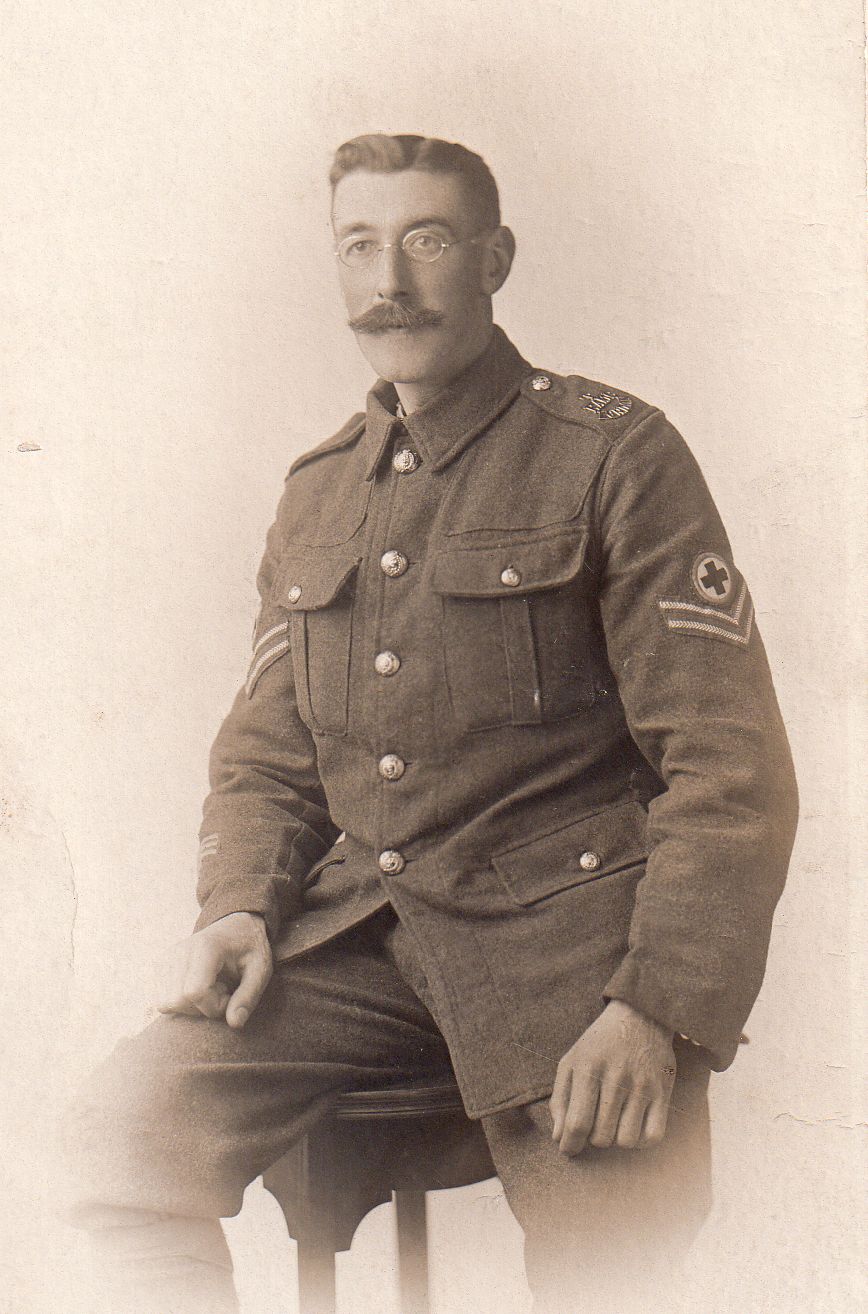
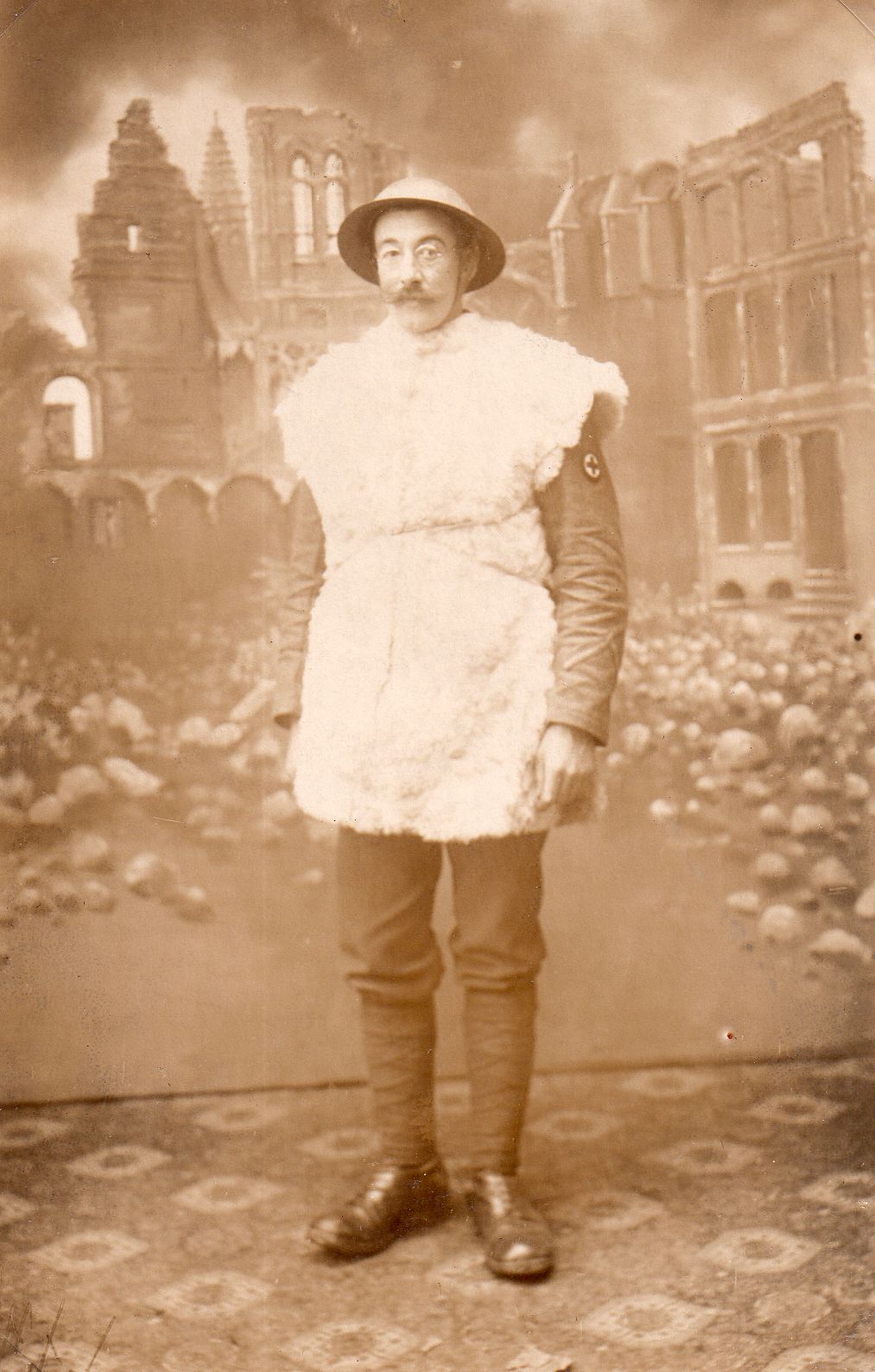
Two images of Arthur Wesley 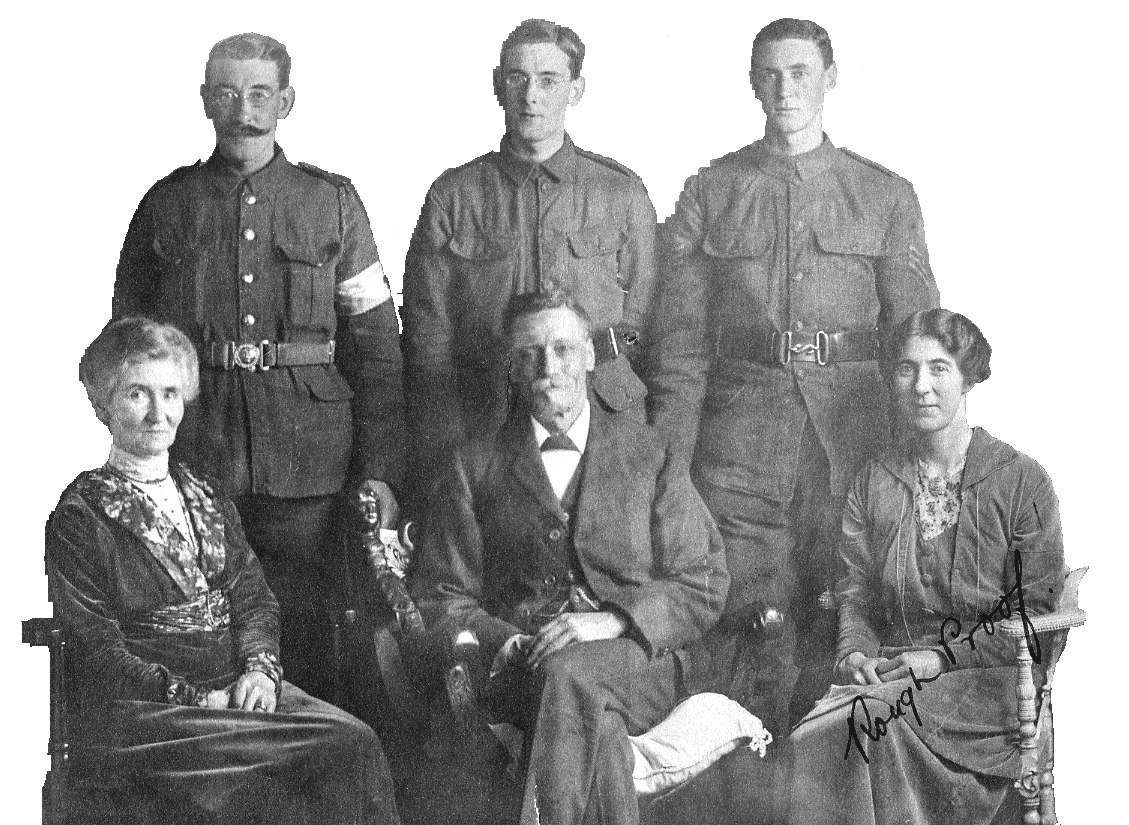 Arthur Wesley, Herbert Stanley and George standing behind
Emily, Arthur Wallis and Elsie Louise
Arthur Wesley, Herbert Stanley and George standing behind
Emily, Arthur Wallis and Elsie Louise
My father never said very much about his service in France and Flanders but after his death in 1946 I found his discharge certificate which said that he had "served with honour and was disabled". I believe his heart was affected by his service, a disability not visible to outsiders. He was sent to the Rectory at Berkswell in Warwickshire which was being used as a convalescent hospital for returning soldiers. One Sunday he went to the service at the Wesleyan Methodist Church at Balsall Common and was invited to lunch at the Elsons' farm - it was there that he met my mother. They were married in the Chapel at Balsall Common on the twelfth of April 1922, Fred Elson signing as the Authorised Person to register marriages and Mary Elson signing as one of the witnesses. Wesley and Laura went to live at 32, Melbourne Avenue, Palmers Green, and there I was born in 1925.
However, all was not well. The grocery business which he had been expecting to return to was no longer there. Probably because of undue reliance on imported goods which could not be obtained in wartime there was no assured future and my father would have to seek employment somewhere else. This was just at the time when the labour market was swamped by multitudes of ex-service men. I understand that my father was employed as a representative (the term then was 'commercial traveller') by several different firms(8) and then eventually worked for a food firm called 'Bestoval' from the late twenties until the end of his life. The area he was responsible for was a large part of North and North-West London and for most of the time this was covered on foot, in buses and trams and in the Underground. He always dressed formally, with wing collar and bowler hat when 'at work' and always wore boots. He must have walked many hundreds of miles in the course of his work.
When the war started in 1939 my father said "We shall all come through the war safely". He was absolutely certain of this - and he was right. He died on the fourth of April 1946, some months after the war through which all four of us had come safely had ended. My mother stayed in Melbourne Avenue until the 'sixties' when she sold the house and came to live with us in Radlett.
My father's two brothers took different routes. George married Elsie Jean Blackett and became a Solicitor's Managing Clerk in a City firm . They had one son, Michael George, who is my cousin. Stanley married Mary Pearl Johns and became an accountant with one of the Railway networks ; they had no children.
If you have followed this account so far you will realise that there is someone missing in this chapter. My Brush grandparents had a daughter, Elsie Louise, and we have heard nothing about her. To make sense of the relationships we must go back to the chapter on my grandparents. The Emily Pleming who married Arthur Brush had a sister Eliza Ann who married Herbert Edward Savage and one of their children was John Herbert Savage , known as 'Jack'. He was a bank manager and married his cousin Elsie Louise and so there was a double link within the family. Jack and Elsie had three sons, Edward Ralph, Alan Frederick and John Douglas - they are my cousins , all three older than I. During the war, Ralph was in the Navy, Alan in the Air Force and John in the Army. Ralph and Alan are still living but John died in 1993.
My cousin Michael, the son of my Uncle George, went in for medicine and held a senior post at St.Thomas' Hospital in London.
But when talking of the cousins, who married who? We have already met a double link with the Plemings and the Savages but this is made a little more complicated when Edward Ralph and John Douglas Savage married two sisters, Barbara Joan and Patricia Muriel Green! And Alan Frederick married Elsie May Dodds. All of them have children and grandchildren but I think it would only muddle you to list them all. Michael George [Brush] married Pamela Joyce Ward and had one daughter, Frances Marion who is the last of the Brushes of that line. She married Peter Romanec in 1992 and their daughter Amy Charlotte was born in the year 2000.
Continued in Part 2
Part 1,
Part 2,
Part 3,
Part 4,
Part 5,
Part 6,
Part 7
Parents Childhood Army Pakenham Radlett Berkhamsted Bourton
Part 1,
Part 2,
Part 3,
Part 4
Parents Childhood Army Pakenham
Part 5,
Part 6,
Part 7
Radlett Berkhamsted Bourton
(1) back to text Hilary and Pippa will surely share the recollection of Dad's voice adding that phrase to the name of someone no longer with us.
(2) back to text I have, exceptionally, amended the original text. It originally read '…famous five' but I know he would have amended it himself the moment Laura was born. Attempts at alliteration are always anticipatable.
(3) back to text Presumably by Mum, I do not recall doing so.
(4) back to text Typically he was too modest. He and Mum had gathered together, at a vast expense of time, everything he could find about those called BRUSH and laboriously written and typed it all up with some narratives for the direct line of descent and offshoots, indexes, individual slips. I have taken that material and tried to develop it another stage in 'The Brush Families of the British Isles' ("BFBI").
(5) back to text The root of our family tree was, I believe, probably not Richard of Tewkesbury but the history pre 1656 is very sketchy. The tree goes back reliably to William of Doughton in Gloucestershire. See the BFBI.
(6) back to text More about Arthur Wallis Brush and family is in section 29.D of the BFBI
(7) back to text More about the Webb family is in section 33.C of the BFBI
(8) back to text Arthur Wesley, and his uncle George Samuel are listed in the Methodist Local Preachers' Who's Who 1934. The reference to c. Finsbury Park must be to the Finsbury Park 'Circuit' which is the main organisatonal unit for the Methodist Church.
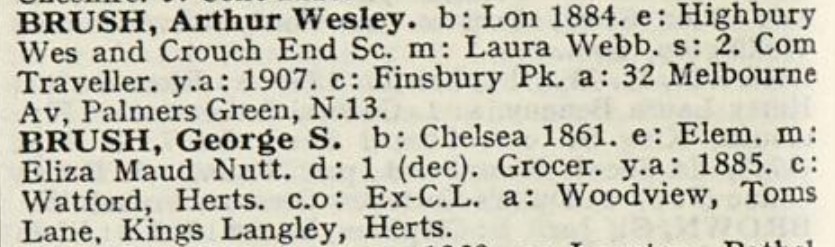
(9) back to text He had begun his sales role by June of 1921. At the 1921 census his personal occupation is listed as 'Sales promoter' , his employment as 'sales' and his place of work as 'London & District' - which is not quite the level of detail that the census instructions expected to be put in those columns. The reason for this seems to be that he was on the census day/night a "visitor" at Abbott Hall, Wesley Guild Holiday Centre, Grange over Sands - a seaside resort in the very north of Lancashire, just south of the Lake District . It was the responsibility of the manager of a hotel etc to fill in the return. It does not look to me as if he was on holiday there. Two schedules were completed for Abbott Hall. The first schedule contains the Manageress and 63 people listed as boarders (later corrected by the enumerator to 'visitor' ). The second schedule contains mostly employees listed as 'helper' pus a few more boarders. And right at the end of the list, afer all the staff, - the 84th named person, is Arthur Wesley uniquely listed by the Manager as a 'Visitor'. It seems clear he was there in a capacity different from all the the other guest boarders but we have no idea why. Maybe some sort of inspection as a member of the Wesley Guild?.