The life of
Fred Wallis BRUSH
1925-2010
Part 1,
Part 2,
Part 3,
Part 4,
Part 5,
Part 6,
Part 7
Parents Childhood Army Pakenham Radlett Berkhamsted Bourton
Part 1,
Part 2,
Part 3,
Part 4
Parents Childhood Army Pakenham
Part 5,
Part 6,
Part 7
Radlett Berkhamsted Bourton
Part 2 : Childhood
A full introduction is in Part 1. Except for correcting a handful of clear typos the main text is exactly as Dad wrote it. The footnotes, the photos and the notes beneath them and the text in bordered panels have been added by me.
On phones, or other narrow screens, text may not appear in bordered panels but is shown in green.
MYSELF - EARLY DAYS
I was born in the back bedroom of 32, Melbourne Avenue, Palmers Green on the third of August 1925. I was told that it was a very hot August Bank Holiday Monday (in those days the Bank Holiday was the first Monday, not the last) and that I was a healthy 'bouncing' baby but things soon started to go wrong and I was taken into the Great Ormond Street Hospital for Children on the fifteenth of August with Pyloric Stenosis and operated on by Mr.Twistington Higgins on the sixteenth. I was discharged from hospital on the twenty-seventh.
At that time I was the youngest baby (thirteen days) ever to have had this operation and there was (I am told) a mention of it in the medical journal 'The Lancet'.
This medical marvel story may be apocryphal. Mr Twistington Higgins was certainly a surgeon at Great Ormond Street and had had papers published in the Lancet on the subject - one earlier in 1925. But no evidence of Dad's operation featuring or of him being the youngest. But the condition is a real one and without an operation probably fatal. As the following extract from the modern Great Ormond Street Hospital website (24/4/2011) explains "there are no alternatives to the operation".
Pyloric stenosis is when the passage between the stomach and small bowel (pylorus) becomes narrower. The passage is made up of muscle, which seems to become thicker than usual, closing up the inside of the passage. This stops milk or food passing into the bowel to be digested. In most cases, a baby with pyloric stenosis will begin bringing up small amounts of milk after feeding. Over a few days this will become worse until the baby can no longer keep any milk down. This vomiting may become so forceful that the milk may be projected for several feet out of the baby's mouth. This is called projectile vomiting. As the milk is lying in the acid in the stomach, it can curdle and become yellow in colour. This also reduces the amount of faeces (poo) passed, as little or no food is reaching the bowel. The effects of pyloric stenosis can become serious quite quickly in children, and so there are no alternatives to the operation. If the condition is not treated, the baby will become dehydrated and not gain weight.
Pyloric stenosis is usually treated in an operation under general anaesthetic, lasting about half an hour. The operation is called a pyloromyotomy. The surgeon will cut through some of the thickened muscle, which widens the passage so that milk and food can pass into the bowel to be digested.
The result of this traumatic experience - though of course I remember nothing of it - was that for some time I had to have minuscule feeds at three-hourly intervals which must have been very wearing for my parents and in addition I lost a lot of weight.
2½ years later, on 29th February 1928 my brother David was born. {David's birth certificate actually shows his birth to have been 27th February}
There are very few recollections of my early childhood to which I can put anything like a definite date. I have all sorts of half-remembered impressions but I cannot tell when or where these events took place but some are remarkably vivid. The feel and smell of my mother's squirrel-fur 'necklet' as I leaned against her during church services. A brilliantly crimson and gold sunset as I sat on the back doorstep.
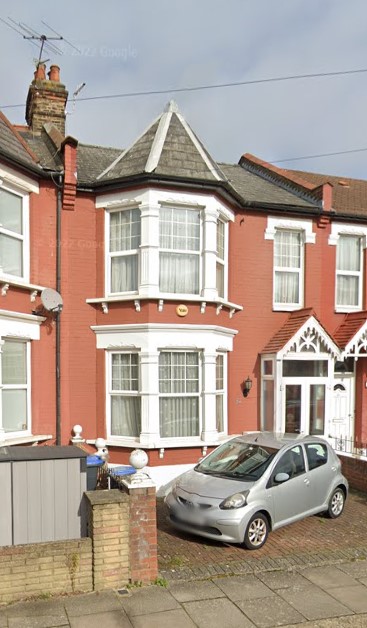
It is very difficult for me to say what our family life was like. Many people when they write of their childhood talk about poverty and hardship and obviously we were not in that category. The house was small - but we managed to fit in. We had no money to waste - but we never went without food and clothes and coal (heating was by open fires). There was an old-fashioned copper in the corner of the kitchen which was stoked up to provide hot water for baths, though much later my mother had the copper removed and a solid fuel boiler installed. There were birthday and Christmas presents and little luxuries. I think it was probably the case that intelligent use was made of what there was and we did not waste time or money on things which were unnecessary. We had a very heavy EKCO wireless, the sort you now see in museums with a cut-out design of trees and a river on the front. Enormously heavy and never to be touched by small boys. Only father could switch it on.
32 Melbourne Avenue as it was in 2022.
Although Dad describes the house as small it does not seem to be unusually so. An unusual exaggeration for Dad?
We had no money to waste - but we never went without food and clothes and coal (heating was by open fires). There was an old-fashioned copper in the corner of the kitchen which was stoked up to provide hot water for baths, though much later my mother had the copper removed and a solid fuel boiler installed. There were birthday and Christmas presents and little luxuries. I think it was probably the case that intelligent use was made of what there was and we did not waste time or money on things which were unnecessary. We had a very heavy EKCO wireless, the sort you now see in museums with a cut-out design of trees and a river on the front. Enormously heavy and never to be touched by small boys. Only father could switch it on.
One Christmas, Mr.Green (who was one of the partners in my father's firm) gave us tickets to a pantomime at a theatre in Drury Lane. It was 'Queen of Hearts', loosely based on the nursery rhyme and it was the first time I had seen a professional stage-show of any sort - I wish I could remember how old I was at the time - and it made an impression on me that has remained to this day. Perhaps it was that pantomime which had an influence on my later dramatic activity. At any rate, I wrote a rather bloodthirsty play about Chinese bandits, using the marble-topped wash-stand in my bedroom as a desk. I forget the plot, but everybody was dead at the end except the British Consul who stood alone, holding the Union Flag.
In those days we were still to some extent in a horse-drawn world. The milkman's cart was horse-drawn and he came round twice a day, first in the early morning and then again about the middle of the morning to see if we wanted any more milk. I can't see that happening today. The coalman had a very large horse pulling his coal-cart, the railway delivery wagons had a pair. There was even an old lady living in Palmers Green who had a carriage and a coachman.
It was also the age of the cinema. Television, although it had been invented, had hardly started to become known. Many families visited the cinema once a week as a regular thing - we didn't but we went occasionally and I can recall the names of some of the films, though the content of the stories have long been forgotten. I think it was most often just my father and myself at the cinema because David was still small.
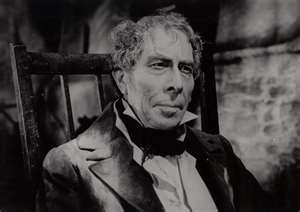
George Arliss was a star at the time, during the 'thirties' and we saw him in 'The Iron Duke' (the Duke of Wellington) and in 'Voltaire'. Two films about Africa were 'Bring 'em Back Alive' and 'Africa Speaks', both I think produced by Frank Buck. Many years later there was much criticism of these films, people saying that the animals filmed had been treated cruelly and that much of the action was faked. Objections were also raised about another film we saw in those days, 'Sanders of the River' starring Paul Robeson. Years later, he said that he regretted making it. However, we enjoyed the films at the time.
George Arliss was a star at the time, during the 'thirties' and we saw him in 'The Iron Duke' (the Duke of Wellington) and in 'Voltaire'.
George Arliss as Wellington
Two films about Africa were 'Bring 'em Back Alive' and 'Africa Speaks', both I think produced by Frank Buck. Many years later there was much criticism of these films, people saying that the animals filmed had been treated cruelly and that much of the action was faked. Objections were also raised about another film we saw in those days, 'Sanders of the River' starring Paul Robeson. Years later, he said that he regretted making it. However, we enjoyed the films at the time.
There were two cinemas in Palmers Green, the Palmadium and the Queen's, the first being the better of the two. There was also a very large new cinema, the 'Ritz', in Bowes Road. Whether the other two cinemas did the same I can't remember but the Palmadium had a Saturday morning children's show which was largely Westerns and cartoons. I went once. From the start of a film I could immediately become enthralled and involved and the Saturday morning show with noisy shouting children all around me was not my idea of enjoyment.
But the 'thirties' were a time of difficulty for many and there were often men, singly or in small groups, singing in the street or perhaps at a busy corner selling matches. It was not an easy time for those without work and unemployment remained a threatening spectre for years - I suppose up to 1939 to some extent.
We often spent some time during school holidays at Berkswell which was to us a second home. I can still feel the spikiness of a hay-field and see the golden lamp-light from a hurricane lamp in the cow-shed. Perhaps now is the moment to pause a little and look back at our time there at the farm.
"LABURNUM HOUSE"
The farm was never called Laburnum House - the address 'Elson, Meeting House Lane' was known to everybody and in fact it was many years before I discovered its official name. It was only small, about sixteen acres(1) I believe, and was really used for the bakery horses providing pasture and hay-crops. There was no arable land. There were often a few bullocks and pigs, but I only remember sheep on one occasion - I remember hearing something to the effect that the land didn't suit them. One or two milking cows were kept until a year or two before the war and of course there were hens. At first there was a light mare, Peggy, who drew a high-wheeled trap, but she had gone by the beginning of the war and the old Wolseley with its celluloid windows and removable roof had been replaced by an Austin of much more modern style. For work on the farm there was Bob, a phlegmatic horse who seemed to undertake any task without any emotion whatever, carting, chain-harrowing, pulling the hay-cutter, tedder or horse-rake, even drawing one of the bread-vans in emergency. He tolerated our demands for bare-back riding round the field though he refused to go faster than a brisk walk. When hay-making came round one or two of the heavier bakery horses would be brought down for the carting.
Hay was put in ricks in the old tradition and thatched by Joe Whately, the farm man. An ex-serviceman, he ran the farm single-handed, seemingly capable of anything. He looked after the large garden and gave me my first lessons in how to grow vegetables and what should be done. He lived further up Meeting House Lane and it was made very clear that he must always be Mr.Whately to us small boys, however he might be addressed by our elders. Always cheerful, he had several sayings which even now stay in my mind. When hay-time came round it was necessary to have extra help and so Mr. Freeman (living almost opposite Joe Whately and another Joe as it happened) who usually worked at the bakery would help and some of the Lidgates would come over from Knowle.
Hall Farm, Knowle, was farmed by Alex Lidgate, the brother of Mary Elson. Alex and his wife Dorothy had three sons and a daughter - Mary, Jim, Robin and John. We sometimes went over to Knowle which gave us an opportunity to explore another farm, much more of a real 'working farm' than Berkswell was.
To return to Berkswell... The house was a fascinating house to us, accustomed as we were to a small London terrace. There were two front doors, two back doors, two staircases. There were two 'grandfather' clocks, one in the front hall and one immediately above it on the landing, as if to emphasise and continue the duplication. They were almost, but not quite, synchronised and in the still of the night I would hear a slow 'tick-tick, tock-tock' from the two of them. The house was, in our eyes, back-to-front, with the front looking out on to the 'Front Field' and beyond to the Kenilworth-Stonebridge Road. The rear of the house looked down the two yards, 'front' yard and 'back' yard, though they were actually parallel, both leading to Meeting House Lane. It was not possible to approach the house from the front, though there was a gateway in the fence bordering the Kenilworth Road and it looks from a map of 1886 that there had originally been a pathway or a drive across the field to the house.
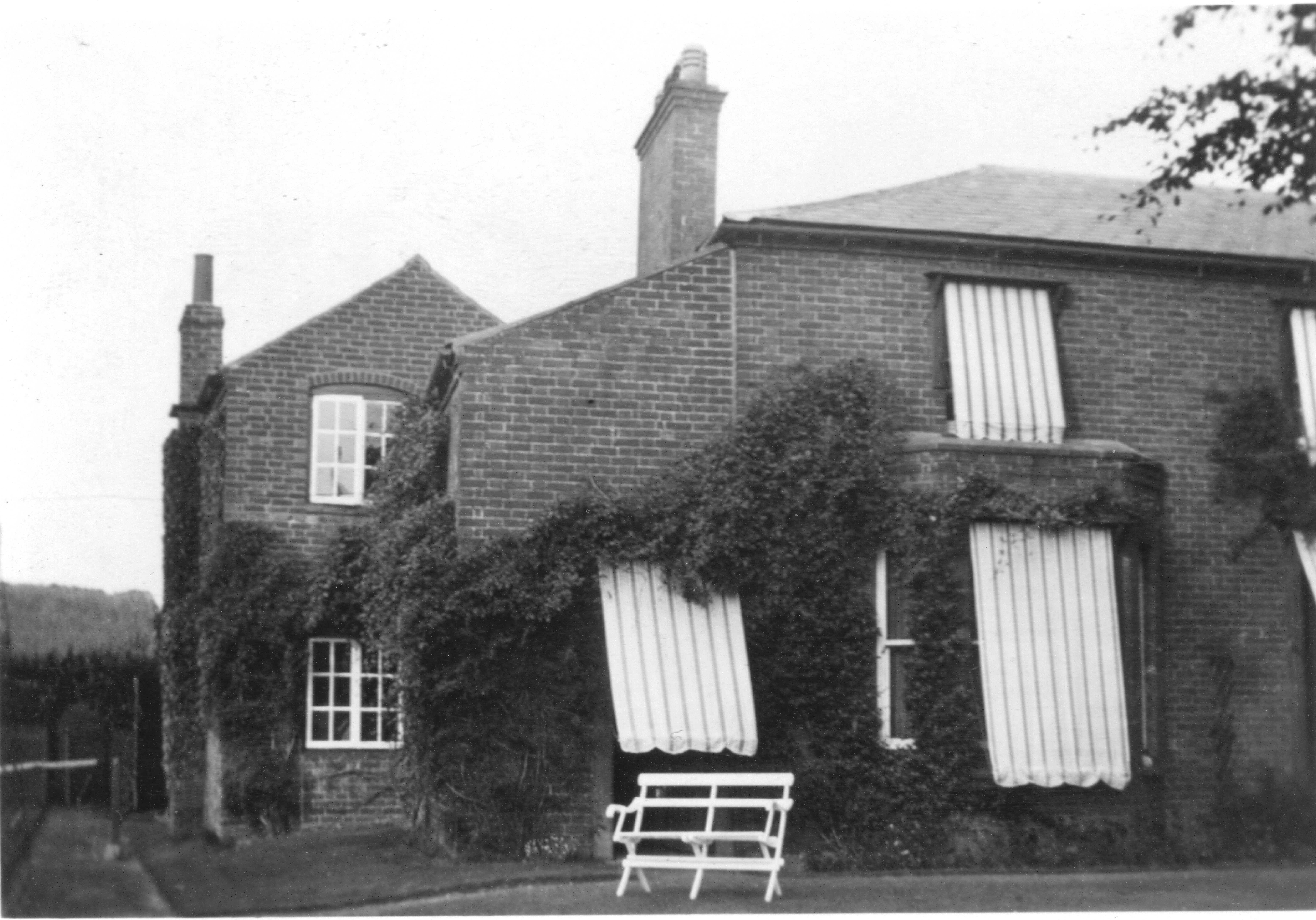 There were shades on the outside of the house to stop the lead paint then used from blistering
The ground floor contained the large farmhouse kitchen, with its coal-burning range and a double-barrelled gun in a cupboard which Joe Whately used for shooting rabbits. The back-kitchen or scullery had a shallow brick sink and a smaller coal-burning range (which I never recall being used). There was a large 'copper' at the far end of the back kitchen, matched by another one just outside in the yard. They may well have shared a chimney. The inner one was for laundry the outer one for pig-killing (which I remember before hygiene regulations made it illegal). A doorway led to the dairy (down a few steps, with a loft above). It was in the dairy one day when I was a toddler that I saw a mouse and stretched out my hand wishing to be friendly. It bit me !
There were four more rooms on the ground floor. The dining room was used on Sundays or special occasions - at all other times we ate at the large kitchen table. The sitting room had Chinese wallpaper and a wonderful three-part cupboard containing a large telescope and a stereoscope with a set of views of Norway. The three-dimensional effect produced by the stereoscope on the old sepia photographs left me with an overriding impression of cold. The 'Oak-room' had dark antique furniture and was a comfortable and friendly 'den'. It was in the Oak-room that I played chess or Rummy or Bezique(2) with Fred Elson in the evenings when homework was done. On the other side of the house was the 'Nursery' with a large table, a roll-top desk, an antique tall-boy and a fireplace which smoked abominably, while between the Oak-room and the rest of the house was a walk-in pantry and the doorway to the cellar steps, the cellar being large and damp and usually we could find fascinating frogs and newts there.
The telephone was in the Oak-room. The number was the same for the house and for the bakery office (Berkswell 5) and there was a crude type of switch on the wall which made it possible to route incoming calls to one or the other. I have no idea how it worked!
The first floor had three 'normal' bedrooms and the master bedroom which connected the front stairs and back stairs and made it possible to go from the other three bedrooms to the bathroom. There was a boxroom and a little room under the eaves where a large tank collected soft rainwater.
There was a fascination about the house in the way that old out-of-date things were still to be found. In an under-stairs cupboard were oil lamps, a clockwork bottle-jack and other relics of days gone past. There were horn tumblers and old domestic equipment such as a knife-cleaning machine.
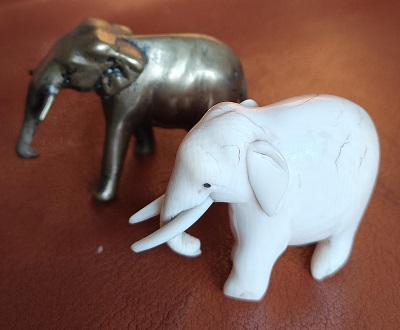
Other than a handful of photos the only thing known to have survived from the Elson household is a small Ivory Elephant believed brought back by a missionary from Ceylon, which Dad got from the Elsons.
The Brass Elephant that accompanies it was bought by Dad age about 12 or 13 (c.1937/8) at Caledonian Market in North London.
But outside, adjoining the Oak-room, was the old bakehouse. Apparently at first the bakery had been at the farm, with the bakehouse and the flour store above built on to the main building. When we knew it, the ovens had long since been removed but my mother told me that the back wall of the old bakehouse, warmed by the heat from the ovens, had grown delicious peaches.
There were the farm buildings one would expect to find on a small farm. In the 'back' yard was the cowshed, calf-pen, separator house, wash-house, chaff-pen, a pigsty used to keep coal in, and the inevitable manure-heap. At the far end of the yard, near the lane, was the rick-yard where the hay-ricks were thatched by Joe Whately and later cut with the enormous (and dangerous) hay-knife and used for the bullocks.
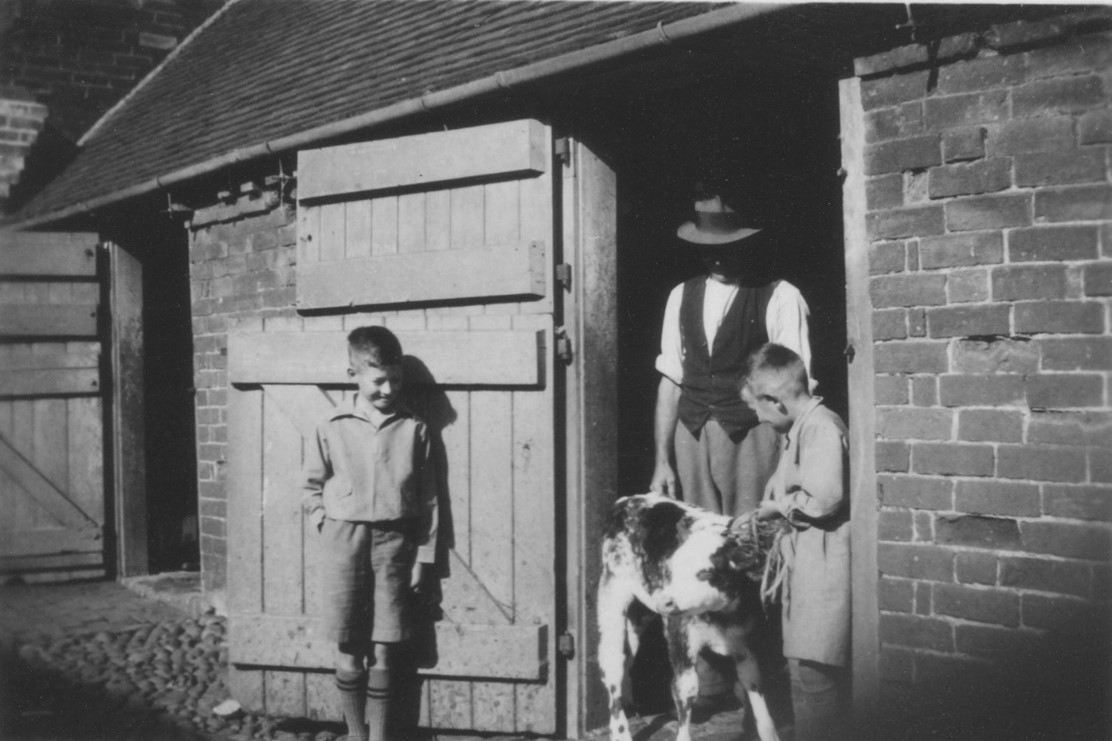 Joe Whately, Dad and David by the Cow shed. Ages? Around 11 and 9? So around 1936? To the left is the separator house (what was this for ?). The calving pen was to the right, not visible.
In the 'front' yard was the stable and coach-house, then used as a garage for the car. A sloping glass roof, known as the Verandah" ran along the back of the house giving a dry pathway from the back door to the bakehouse door and also a pleasant place to sit outside at the right time of day. And right outside the back of the house was a large wooden building, the billiard-room. This had two doors for some unknown reason, one being completely useless since it was covered by many years' growth of wisteria. It contained (apart from the obvious billiard table and its accessories) a large number of books, two large palm-leaf fans, and a harmonium! It was in the billiard room that David and I played our one and only duet 'O for the wings of a dove' arranged for harmonium and dinner-gong.
The fact that there was no running water and that all our requirements had to be met from the cast-iron pump outside the back door increased our delight, for the water had a taste of its own, very different from the insipid water of our taps at home. I think we were even rather sorry that there was electricity, but the old oil lamps were still there, in a cupboard under the stairs. There were other things there too which now I see in 'antiques' shops and museums - they were no longer in use but had never been disposed of.
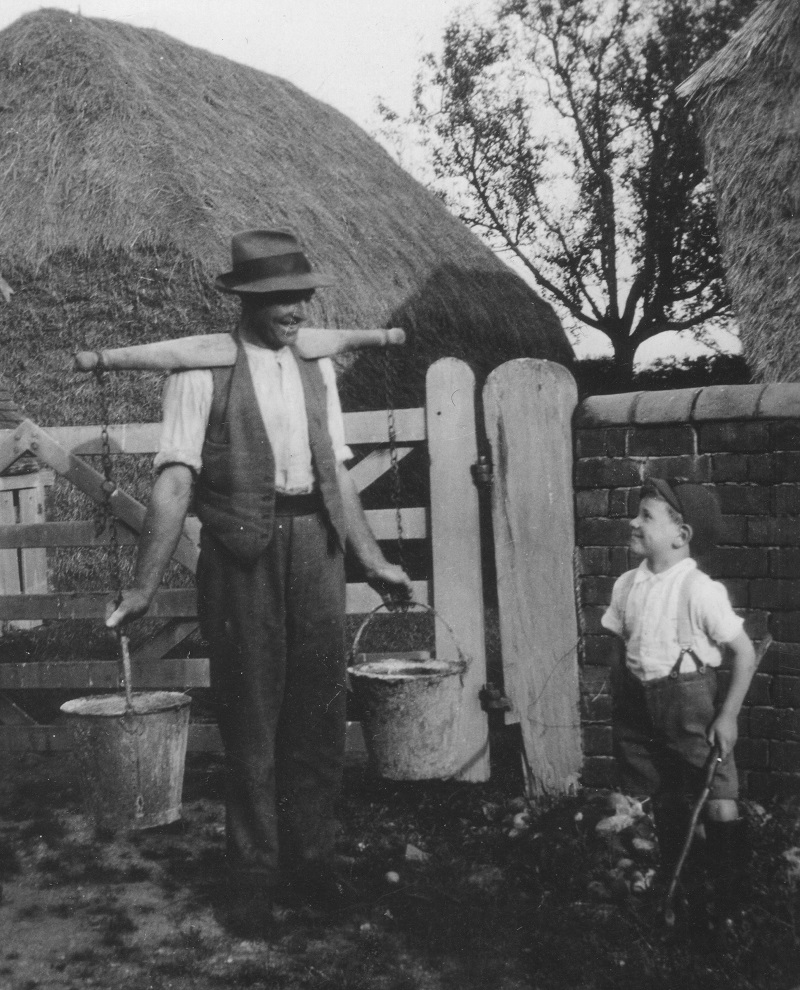
The garden seemed to be enormous, with a large part given up to growing vegetables for the house, and two lawns. One lawn had two great trees, a copper beech and a sweet chestnut which supported our swing, and was separated from the 'Front Field' by a holly hedge and an iron fence, the narrow space between the two being filled with daffodils. The other was used for croquet and tennis and at the end was a little summer-house, used for the garden seats, tennis nets and other games things in the winter months. Up at the top of the vegetable garden was a gate which led into the pig-field, where two sties usually housed three or four pigs. In the rick-yard was an enormous tub, let into the ground so that only about a foot or eighteen inches were visible and into this went all the household kitchen waste. With a long-handled ladle, Joe Whately put the resulting 'soup' into buckets, mixed in sharps or middlings(3) and carried the buckets, with an old-fashioned yoke, up the garden to feed the pigs. The mixture must have been a near-lethal brew of bacteria but the pigs ate it greedily and thrived on it.
The 'Business', as it was known, consisted of the bakery and shop at the junction of Meeting House Lane and Station Road, with a house attached and the necessary stables and cart-shed. Although a motor van was bought just before the War, most of the deliveries of bread were done by horse-drawn high-wheeled vans and the heavy deliveries of corn and meal by flat drays with a little raised seat in front. There were two coke-fired ovens in the bakehouse, one above the other, and by a clever arrangement of a pit in front of them and a large wooden box as a platform both could be reached easily when required. Percy Briscoe was the head baker, a kind plumpish gentleman who was the Sunday School Superintendent at the Chapel on Sundays. Above the bakehouse were the flour stores, so arranged that the ingredients for the bread could be sent by a chute down to the mixing machine below. The horse and bread-van would be brought into the covered area between the shop and the bakehouse, the bread would be thrown up to the driver two loaves at a time, and then the big sliding door would be opened on to Meeting House Lane and off they would go. I believe the rounds were quite lengthy in some cases, the two or three vans covering a wide area. I can still remember some of the horses, the light van-horses Jim and Kitty and the heavier dray-horses Captain and Jewel. These horses seemed to be always there but a horse called 'Butter' (a name inspired by his figure) appeared for a brief time.
There was one sad experience with Jenny, a little Welsh pony which Fred Elson bought so that we could learn to ride. Delivered to the farm, she was left in the top field we knew as the 'blackberry' field for the night - in the evening of the following day she was writhing on the ground, obviously in great distress. The vet was called, we boys were told to stay in the house, and Jenny was shot and removed. I have no idea what was wrong, but sadly there was no second time.
The office at the 'Business' was a very old-fashioned 'counting house' type of room, with a sloping desk running along the length of the wall and high stools to sit on and it was the domain of Elson Howell, who I understood was some sort of cousin of Fred Elson though the relationship was never explained - and in those days I was not really interested.
He and his wife Kitty lived in a little cottage in Meeting House Lane opposite the yard gates of the farm.
On Sundays we would go in the car to the house of a Mr.Hallam in the Kenilworth Road, park the car there and walk the remaining short distance to the Chapel, which is now demolished. A plain building with a school-room behind and a little porch to shelter the entering worshippers, wooden pews and a central pulpit, it was the typical village Methodist Chapel. On the left as one faced the pulpit was the harmonium, played every Sunday by Fred Elson. The story had it that the organist had failed to arrive one Sunday morning. Eli Elson, his father, said to his son Fred, then a boy of fourteen, "Go on, you can play." and, after a consultation with the preacher to select some hymns young Fred knew, he did exactly that - for the next sixty years. In 1934 he was presented with a copy of the Methodist Hymn-Book with Tunes, then newly produced after the union of Wesleyan and Primitive Methodism, inscribed "Presented to Fred W. Elson by the Members and Friends of the Balsall Methodist Church and School. An appreciation of his services as Organist of this Church for over fifty years. March 11th 1934" I still have the book, together with a small newspaper cutting recording this occasion. It was about this time, I believe, that Norman Cooper began to play more frequently as deputy organist.
Frequently on Sundays when the preacher was "planned" (4)to take both services he would come to Sunday dinner and tea. Most of them spent the afternoon in a comfortable chair (meditating?)(5) but there was one younger minister who played ferocious games of croquet with no strokes/barred. Fred Elson's connection with Methodism was considerable. Both in the affairs of the local chapel and in the life of the Coventry Circuit he took a very active part. I remember seeing a photograph (now unfortunately disappeared) of a Fete in the 'Front Field' and I have another newspaper cutting which tells of the Centenary Celebrations of the Chapel held in 1925 at the Balsall Institute, at which he spoke of the Chapel and its history. He also took a part in local government, being a Councillor and a J.P. I know that many people came to him for advice and help, valuing his knowledge and wisdom. To my brother and myself he amply made up for the real grandfathers we had never known and Mary Jane Elson was the perfect grandmother. Equally devoted to her Chapel, I well recall her singing hymns in a firm contralto while about her housework. She claimed that the Lidgates originated from Scotland and she had a great love of Scottish metrical psalm tunes.
The farm was on the boundary of two civil parishes, which is why the house and half the farm was in Berkswell and the business and the other half of the farm was in Balsall Common. David and I used to cycle or sometimes walk to Berkswell village where a set of stocks stood in the village green, with four gigantic elm trees. The trees were felled because they had succumbed to Dutch Elm Disease but at least four more trees have now been planted to replace them. In the middle of the village is a large square walled pool where a spring bubbled up and the local cottagers used to collect their water and in those days the water in the well was drinkable (even if it did have caddis-worms in it!). The last time I went to Berkswell, many years later, there was rubbish thrown in and the water seemed to have dried up. I hope things have been altered for the better again. In those days the Church was unlocked; this is no longer so. I think my first ideas of church architecture sprang from wandering in Berkswell Church. In my year at Leamington College I did a little project on Berkswell Church - now like many other documents, lost.
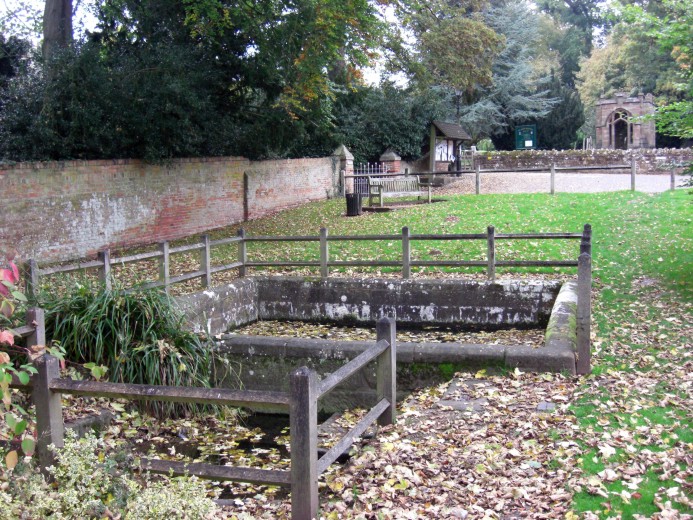
The square well and the church
The square well
Berkswell Church
[This chapter is based to some extent on an article I had published in "Berkswell Miscellany Volume VI" by the Berkswell Local History Research Group in 1990.]
SCHOOL DAYS
In 1928 my brother David was born, not at home put in a nursing home at New Southgate. Like all brothers we had ups and downs; we played together happily and we quarrelled.(6) Some of my happiest memories are of times when there were just the two of us engaged in our own private games or adventures with no-one else to intrude on our enjoyment.
So time passed and it was time to go to school. I can remember vividly going with my parents to Bowes Road School and running across the school hall to the table where Miss Wills,the elderly headmistress, was sitting. She spoke to me and I turned tail and fled back to the security of my mother! Once having enrolled, my academic career had begun. In turn Mrs.Newman, Miss Hawkins (who couldn't pronounce her 'r's and addressed me as Fweddy), and Miss Alard took me under their wings. There must have been at least one other but I can only remember those three. It was in Miss Alard's class that one wet play-time when we were allowed to stay in the class-room I was tackled by Edna, a large girl, bent backwards over a desk and forcibly kissed - an experience which must have left its indelible mark on my personality. It may have affected Edna too, for later she became a nun.
The school was of the same style as many London Schools. Three floors, Infants on the ground floor, Juniors on the middle floor and 'Seniors' (about whom more later) on the top floor. There were two playgrounds, one for girls and infants and one for boys, the whole school and playgrounds encircled by a wall with tall iron railings (I think to stop us getting out). In the girls' playground there was an open-sided structure which was intended to shelter us from the rain - I don't recall one in the boys' playground, perhaps we were allowed to stay in the classrooms in wet weather. There was a large assembly hall on the ground floor in which we sat on the floor and were addressed by the Headmistress. I remember Mr.Gooding, the caretaker, coming in as the light faded in the winter afternoons and lighting the large gas-lamps with a taper fixed on the end of a pole. In those days we celebrated Empire Day, for we had an Empire to celebrate. Usually we had some sort of play-cum-pageant involving the whole class, followed by a half-holiday. In one of these I was playing the part of a judge and my mother performed a minor miracle and made a very presentable wig out of cotton wool. One of my most vivid memories is of marching out of the Friday afternoon school assembly to the tune of 'Old Father Thames' or Percy Grainger's 'Country Garden' played (week after alternate week) by Miss Hawkins at the piano. So infant and junior school days passed, and eventually I was in the top class under the first master, Mr.Sinden. Then the time came for 'the Scholarship'.
This was, of course, a misnomer. It was really what was later (and probably at the time) known as the ll-plus, an examination in English and Arithmetic to see whether we were destined to move to the Secondary Schools or to go to the top floor of Bowes Road School and be the 'Seniors' I have already mentioned. I passed and chose to go to Minchenden and so I ended my last term at Bowes Road. Some two or three years earlier, Miss Wills the Headmistress had retired and her place had been taken by Mr.Isaac as Headmaster. During the Summer holiday after I left, Mr.Isaac was apparently playing golf when he was stung on the eyelid by some insect - and developed an infection and died. I believe that Mr. Sinden took over as Headmaster at the start of the following term but I was then at Minchenden.
Minchenden was a County Secondary School. It was not free - my father had to pay £5 per term, which in those pre-war days was quite a lot (probably about £100 in today's monev). Equipped with all the necessary impedimenta and dressed in green blazer and cap, with appropriate badges on both I took the next step up the ladder.
Minchenden was housed partly in an old house at some time the property of Lawrence of the Punjab. A modern and architecturally very different building was connected to the old house and only staff and prefects were permitted to ascend the steps to the front door. The connection between the two buildings was by the room (I seem to remember it was hexagonal) known as the old dairy and each morning at the top of a short flight of steps leading out of the dairy Mr.Bromley would tug at a wire rope to sound the bell. Signals during the day were by electric bell of course but the tradition of the hand-rung bell to start the school day lingered on.
Whether Minchenden was a good school or not is a matter I have often thought about. Certainly it had good examination results in the General School Certificate and Higher School Certificate examinations of those days and a respectable number of its pupils went on to universities, but in some respects I feel that true education, in the sense of preparation for life, was lacking. Of course much depended on the quality of the staff. I remember the names of those with whom I came into contact: Miss Smith for French, Mr.Hayter for Maths, Miss Crossley for English, Miss Nolan for History, Mr.Stewart for Geography, Mr.Rooth for Physics, Miss Richards for Chemistry, Major Hedlev for P.E., Mr.Gooch for Woodwork. In Art and Music, two subjects which were not pursued above the lower forms, I would say that I received nothing. To draw, very unsuccessfully, a daffodil and to sing, very feebly, 'Linden Lea' left me completely ignorant of art and music in the wider sense.
I was put into Form 1Q. Although the normal entry went for five years through Forms 1, 2, 3, 4 and 5 one group who were considered to show promise did the G.S.C. course in four years, in forms 1Q, 2Q, Lower 4 and Lower 5. As things turned out in my case, neither of these routes applied.
I started in Form 1Q in September 1937(7) and in 2Q in September 1938. I did well in English, Maths, French and the Sciences, with less success in History and Geography. The reports are full of 'Good', 'Very Good' and even ''Excellent'. It looked as if things were set fair for steady progress.
In the Summer of 1939 we were all at Berkswell as was our custom. We had been to Felixstowe for a seaside break (whether a week or fortnight I don't remember) but for the rest of the time we went as usual to the farm. While we were there war was declared.(8) It was decided that my mother, David and myself should stay at Berkswell and that my father would visit us as and when he could. Two or three years earlier he had bought a car, a £115 Popular Ford, but we had not yet realised that petrol rationing would limit the use of it.
Mary Elson had died the year before and so my mother was also housekeeper. With Fred Elson and the three of us we were registered as one household when identity cards were instituted - I can still remember my number, OFEO 143/3. (This card, incidentally, was taken away when I went in the army and on demobilisation in 1947 I was given a new one with a new number - and I have never been able to remember that one).
It was decided that David and I would go to Leamington College for Boys, in Binswood Avenue, Leamington Spa. This meant travelling by train morning and evening and several factors affected our journey. To start with, we had to catch an early train which went to Coventry and there we had to change trains and wait, sometimes for a very long time. For various reasons about which we knew nothing the times were frequently altered. I remember standing on Berkswell station one day as a train full of soldiers went through - later we realised they were troops evacuated from Dunkirk. It was possible on one or two occasions to get a through train from Berkswell to Warwick Milverton but usually our connection from Coventry deposited us at Leamington - in either case we then had a walk from the station to the school. We always arrived late, after the lesson had started and similarly in the evening we had to leave early in order to catch a train home, with a probable wait at Coventry.
This state of affairs gave opportunity for various other activities too. It was on a train to school one day that I tried my first cigarette (in those days cigarettes were cheap and were obtainable from slot-machines on station platforms). I don't remember if I enjoyed it but my companions scared me by saying I had singed my eyebrows - I lived that day in fear of being found out until I managed to get to a mirror when I discovered they had been pulling my leg. I did not enjoy my time at Leamington. Apart from the disorder of arrival and departure there were other factors which affected school life. Because we came from a distance it was impossible to have any friendships. The form I was put into, 4a, had already done two years of Latin - I had only done one year and I never caught up. In French however I found I was a year ahead so that I was repeating the text-book I had used at Minchenden. Not surprisingly I did very well. A few names of the staff stay in my memory - Mr. Olorenshaw who taught English and History, Mr.Davey for Latin, Mr.Austin for French and Mr.Foss for P.E. (he sported a Hitler-type moustache which was unfortunate in 1940 to say the least).
Leamington played Rugby football, Minchenden soccer, so we were excused. 'Dig for Victory' was the slogan then and part of the school field had been measured off as small allotments. David and I took one of these and grew potatoes, cultivating the plot during games afternoons.
Then, as the summer term drew to its close, Fred Elson died and we returned to London. At least, I returned first, Mother and David staying until the farm and business were sold and Berkswell, as we knew it was no more. And that is now literally true. The house has been pulled down and three or four houses have been built on the site.
I went back to Minchenden, was placed in Form Lower V and started the preparation for G.S.C exams. The syllabus was more restricted and I dropped Geography, Latin and Biology, together with the Art and Music mentioned earlier. Those war-time days in 1940 and 1941 were often interrupted by air-raid warnings when we all went to the shelters, excavated on the playing field near to the old building. At times these were [?long?] intervals until the All-Clear sounded and we could go back into lessons. There was a period, also, when we attended school only for part of the day, another school from Wood Green using our buildings in a shift system. All in all, the conditions under which we prepared for examinations would have horrified the educational 'experts' of today. Still, we managed, and I passed G.S.C. with the requisite standard for Matriculation.
In Lower VI Science I concentrated on four subjects - Chemistry, Physics, Pure Maths and Applied Maths. Once or twice a week we had an English lesson in which Miss Crossley attempted to give some culture to the (presumably) uncultured Scientists. As far as I know the reverse was not tried with Lower VI Arts. I don't think this effort to civilise us was very succesful since it was almost entirely given over to reading the plays of George Bernard Shaw - an author I was not attracted to then and find even less attractive now. We did vary this for a short time by reading plays by Galsworthy; even then I could see that they dealt with an era that was past.
A further attempt was made to give us at least the rudiments of musical culture by taking the Sixth Form up to London to a performance of 'Traviata' and to the ballet. From 'Traviata! has developed my enjoyment of opera but I'm afraid the ballet left me cold (they were 'Sylphides' and 'The Rake's Progress').
To some extent the 'black-out' affected our lives but we learned to put up with the inconvenience. Cars and cycles had shields fitted to their lamps so that as little light showed as was consistent with being able to see where we were going. All windows in houses had to have curtains which stopped any light escaping and in some cases windows which were not accessible (such as skylights) were painted with black paint. Street lamps were not used and we had to be careful of obstructions like trees - they had white bands painted so that we could avoid them. Quite often on a Friday evening I cycled over to Enfield where my uncle George lived and we played chess. I was able sometimes to help my cousin Michael with his chemistry homework. They were more worried than I was about my journey in the dark - I quite enjoyed it.
In the Sixth Form we took our turn at 'fire-watching', two pupils and a teacher sleeping at the school with the idea that we might be able to tackle incendiary bombs should they fall on the school. Fortunately we had peaceful nights. In 1943 I sat the H.S.C. exam and was successful in all four subjects, giving me in addition to the H.S.C. my Inter-B.Sc exemption. What would come next?
Here, I am afraid, we have to expose a serious shortcoming in information. What I wanted to do was to go to one of the Universities to read Chemistry with a view to teaching that subject later. At that time conscription had been introduced and at the age of eighteen I would be liable for call-up unless I was given deferment until an approved course of study was completed. When I enquired about this I was told by whichever of the staff was dealing with the matter that I would not be given deferment for Chemistry but that I could be deferred if I read Physics - which I did not want to do. What was I to do? To my great annoyance I discovered after the war was over that I could have been deferred to read Chemistry -_the information I had been given at school was not correct.
However, I didn't know that then, The future seemed completely empty with no discernible path. I began to make enquiries and I discovered that there was a scheme in operation which involved a six-month University Course followed by a commission in certain Corps. This seemed promising and I applied. It involved joining the Army first, which I did on 26th May at Holloway, enlisting in the General Service Corps, and then being interviewed at Horse Guards Parade on 21st July. But I was not accepted. Instead I was told to go home and wait to be called up with my age-group. Again my plans had fallen through.
I left Minchenden in July 1943. Looking around for a temporary job I joined British Drug Houses in their packing and labelling department at Islington where at least I was dealing with chemicals and knew what the names meant! It was not for long. In November I was told to report to No. 9 Primary Training Centre at Maryhill Barracks, Glasgow, before 6 p.m on 17th November. A railway warrant was enclosed, together with a Postal Order for five shillings, an advance of pay.
And what happened then is found in the next chapter.
Part 1,
Part 2,
Part 3,
Part 4,
Part 5,
Part 6,
Part 7
Parents Childhood Army Pakenham Radlett Berkhamsted Bourton
Part 1,
Part 2,
Part 3,
Part 4
Parents Childhood Army Pakenham
Part 5,
Part 6,
Part 7
Radlett Berkhamsted Bourton
(1) back to text In his 1990 Berkswell article and the original text of this document Dad said sixty - but he later amended his typewritten text and added sixteen in handwriting, albeit with a question mark. This is almost certainly the correct figure.
(2) back to text Bezique is a card game. Even by the 1960s (when Mum and dad still played) it was already something unusual. It had its own special box and scoring card and the pack was different to a regular pack.
(3) back to text
In the process of milling wheat, to produce flour, the wheat kernel is ground and sifted. The larger particles are separated as bran, while the finer particles are classified as middlings or sharps, which are often used in animal feed due to their nutrient content.
'Pigswill' survived as a recognised way of using up old food until 2001 when a foot and mouth outbreak finally put paid to it, though it had been subject to increasing regulations about 'treatment' before being fed to pigs. I can clearly recall waste food from school dinners in the 60s going into big metal swill bins and then collected by a lorry.
(4) back to text The 'plan' was very much a part of Methodist life - certainly as I remember it from the sixties. Produced quarterly (I think) it listed all the services across the circuit of churches and which minister or local preacher would be preaching at each service.
(5) back to text The phrase 'meditating with the eyes closed' was frequently used by Dad when I was a child - mostly describing an after lunch nap.
(6) back to text Lizi told me, many years ago, of a poignant memory of Dad discouraging her and Nicola from quarrelling and expressing his regrets for quarrels with his much missed brother.
(7) back to text starting secondary school at age 12, rather than 11 as it is now.
(8) back to text 3rd September 1939.