Section 29 : Direct Line 1809-1946
Section 29.E
Arthur Wesley BRUSH
1884-1946
Arthur Wesley Brush was my grandfather, though he died before I was born. He was born on 6th November 1884 at 190a Holloway Road, in Highbury ( a north London suburb), the son of Arthur Wallis Brush and Emily nee Pleming. This was the family home, above a little shop which his father had bought or rented around the time of his marriage. The choice of Wesley as his middle name reflects his parent's commitment to Methodism - his father was a Methodist local preacher. As far as I can tell he was usually known as Wesley rather than as Arthur. His father is considered in section 29.D and the Pleming family in section 34. He was one of four children. His siblings Elsie Louise, George Douglas and Herbert Stanley are considered in Section 29.F.
Arthur Wesley was baptised at Highbury Wesleyan Methodist Chapel in 1885:
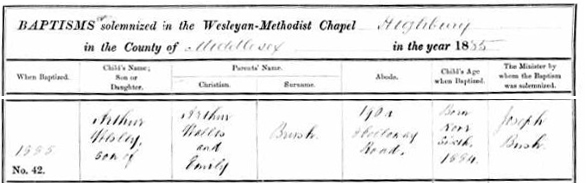
The baptism was sometime on or before May 27th when the next baptism occurs. Unusually the actual date is not shown. (Ancestry indexes the register entry as Bursh) The minister by whom the baptism was solemnized seems to have been Joseph Bush - for a moment I thought we had found another Brush.
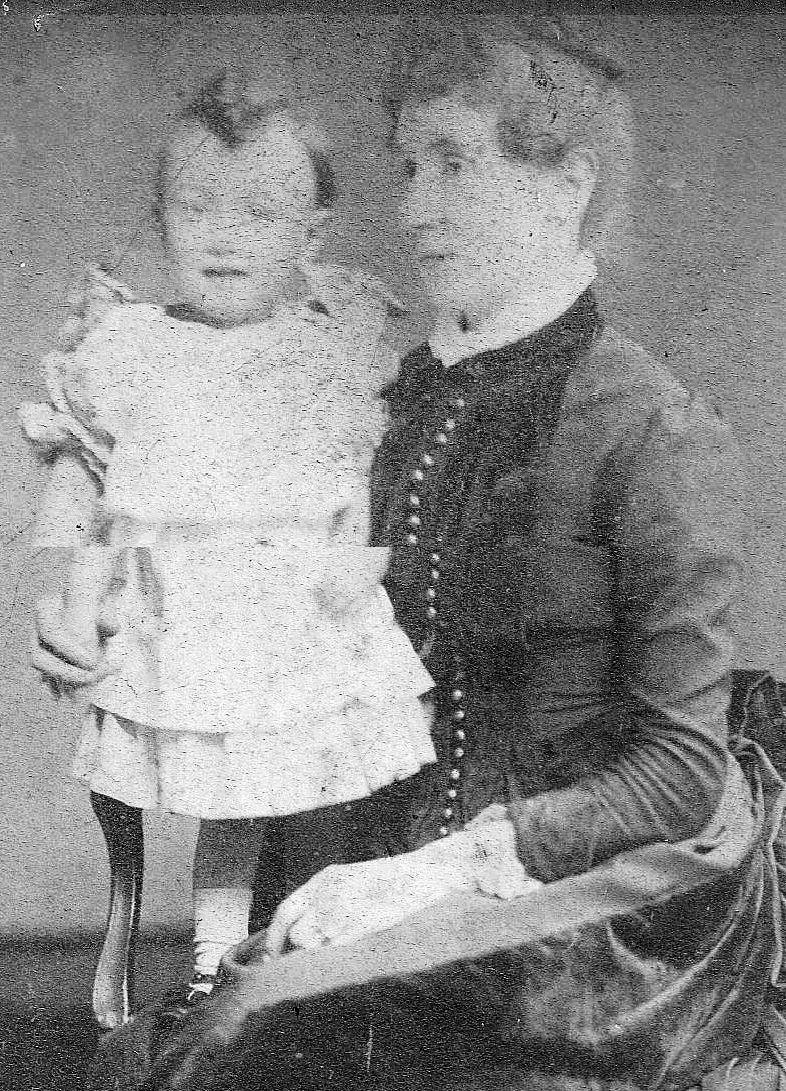
 Emily with infant son Arthur Wesley in 1885/6
"He claimed that he could be counted as a true Cockney because (so he said) he could hear Bow bells from Holloway Road, though I think this is very much a case of wishful thinking. In no other particular could he be accused of 'cockneyism'." This comment, and all the passages below in italics, are from Part 1 of my father's autobiography, writing about his father.
The family was still at 190a Holloway Road at the 1891 census. Arthur Wesley and 4 year old Elsie Louise were both listed as scholars. And the family had a domestic servant, 15 year old Nelly McMahon. In 1892 it seems that Emily's sister - Wesley's aunt - Marie Louise Pleming was also living with them before her marriage to John Cory.
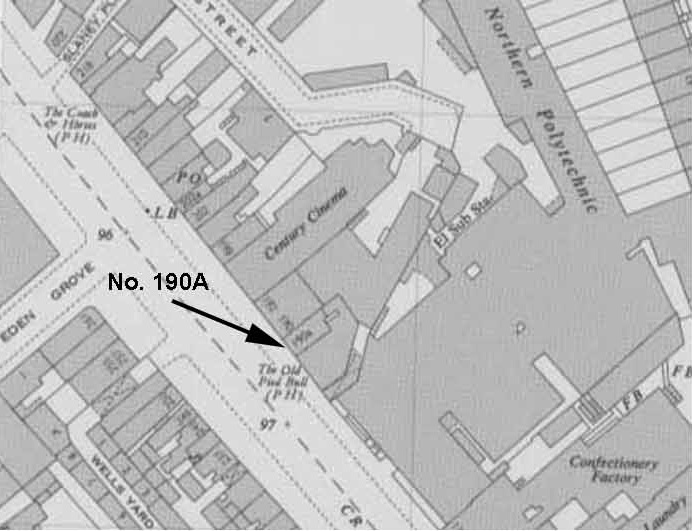
It was next door to the Old Pied Bull pub, which may have been an irritation to a Wesleyan Methodist:family. The shop was also in the shadow of the large facade of the Northern Polytechnic - which, by one of life's coincidences, my father attended some 57 years later.
LPA Image(awaiting consent)
Above, as seen on the London Picture Archive site. The image is from much later - 1958. 190A is the narrow building with the shop boarded up. The image below is from 1906 - obtained thanks to of the Islington History Society.
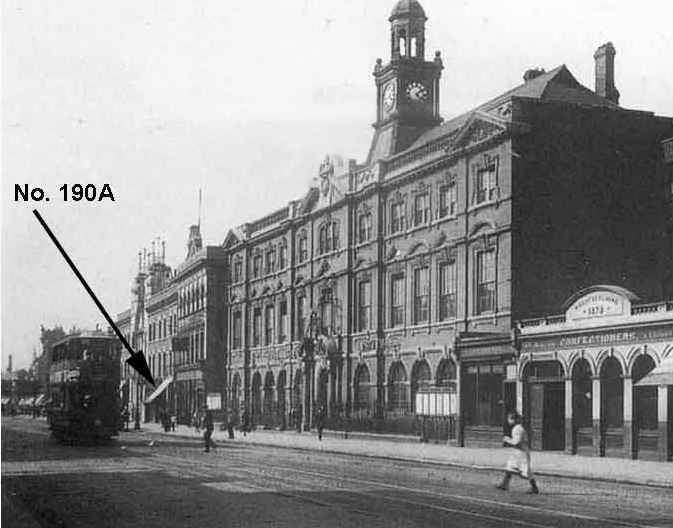 In 1891 the trams would have been horse drawn rather than electric
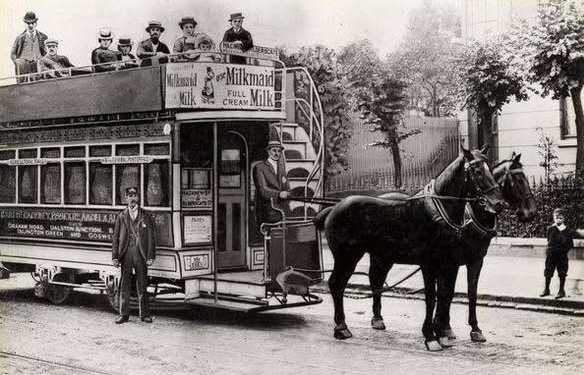
He went to school at 'Highbury Wes and Crouch End Sc'. This little bit of detail comes from a 1934 "Who's Who" of Methodist Local Preachers(1). The Highbury Wesleyan School was a voluntary day elementary school attached to the Highbury Wesleyan Chapel. By the time Arthur Wesley was a young schoolboy the school was in purpose built school buildings only about 300m from their home. According to the Victoria County History (2) the school had "Opened 1860 as Highbury Wesleyan School for Boys and Girls in room under church. Financed by school pence (4d.), voluntary contributions, parliamentary grants from 1866. Roll 1860: 58 boys and 27 girls. New building 1866 for boys, girls and infants; average attendance 125 boys, 45 girls, 60 infants. Roll 1871: 161 boys, 135 girls, 132 infants; 1878 accommodation 578, average attendance 433. " Full public funding of elementary schools did not come until the 1891 Elementary Education Act which required central government to pay a 'fee grant' of ten shillings (50p) for each child between the ages of 3 and 15 and by prohibiting the charging of fees in elementary schools.
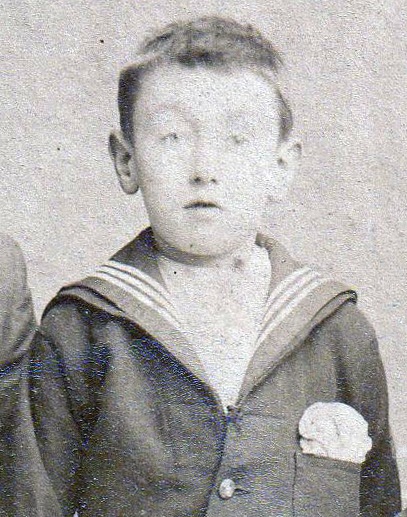 Arthur Wesley - from a family group around 1892
,
The full image is in Section 29.D
It seems a reasonable assumption from this, and the 1885 baptism, that the family also worshipped at the Highbury Wesleyan Chapel which was a substantial and rather grand mock gothic building seating 1,023 people built around 1857. That is a big church - the modern capacty of St Peter's Berkhamsted ( a substantial church which my immedate family are familiar with) is said to be around 400 although in 1902 Kelly's directory said it could seat up to 1100.
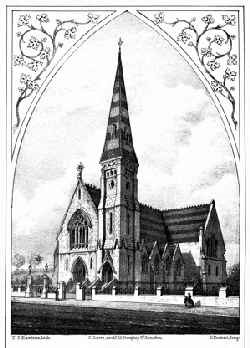 Highbury Wesleyan Chapel, long demolished
In the summer of 1895 the family moved house to 2 Victoria Terrace in Hornsey. They are still at Victoria Terrace at the 1901 census. Father Arthur Wallis Brush was listed as a Grocer and 16 year old Arthur Wesley as a Grocer's Assistant. Victoria Terrace is close to Finsbury Park and the photo images on Google Maps suggest the 1901 house is still there. The family shop also moved around this time to Tottenham Lane in Hornsey. I'm not sure where this bit of detail came from. Electoral rolls?
 2 Victoria Terrace, as it now looks.
The second school mentioned earlier was Crouch End School,
By 1911 they had moved to 'The Shrubbery', Gordon Road, Hornsey - now no longer there since it was demolished and the whole area redeveloped many years later. According to the 1911 census the house had 7 rooms. That the family lived in a house called the Shrubbery has special echoes for me. Throughout my time at secondary school, in the late nineteen sixties and early seventies, I was known as 'Shrub' - it being an anagram of Brush. Was the same name game played 60 years earlier?
"... up to the outbreak of the Great War in 1914 [Arthur Wesley] was employed in [his father's business] and the business seems to have changed gradually with increasing trade in the importation of spices , coconut and tea (which [Arthur Wesley] blended himself for different tastes). They also manufactured proprietary items such as 'Gravy Salt' and 'Gravythick' and traded then as A.W.Brush and Sons at Castle Works, Hornsey, though I do not know where the 'works' were situated; it may well have been at 'The Shrubbery' for I remember there were several outbuildings and store rooms as well as the house."
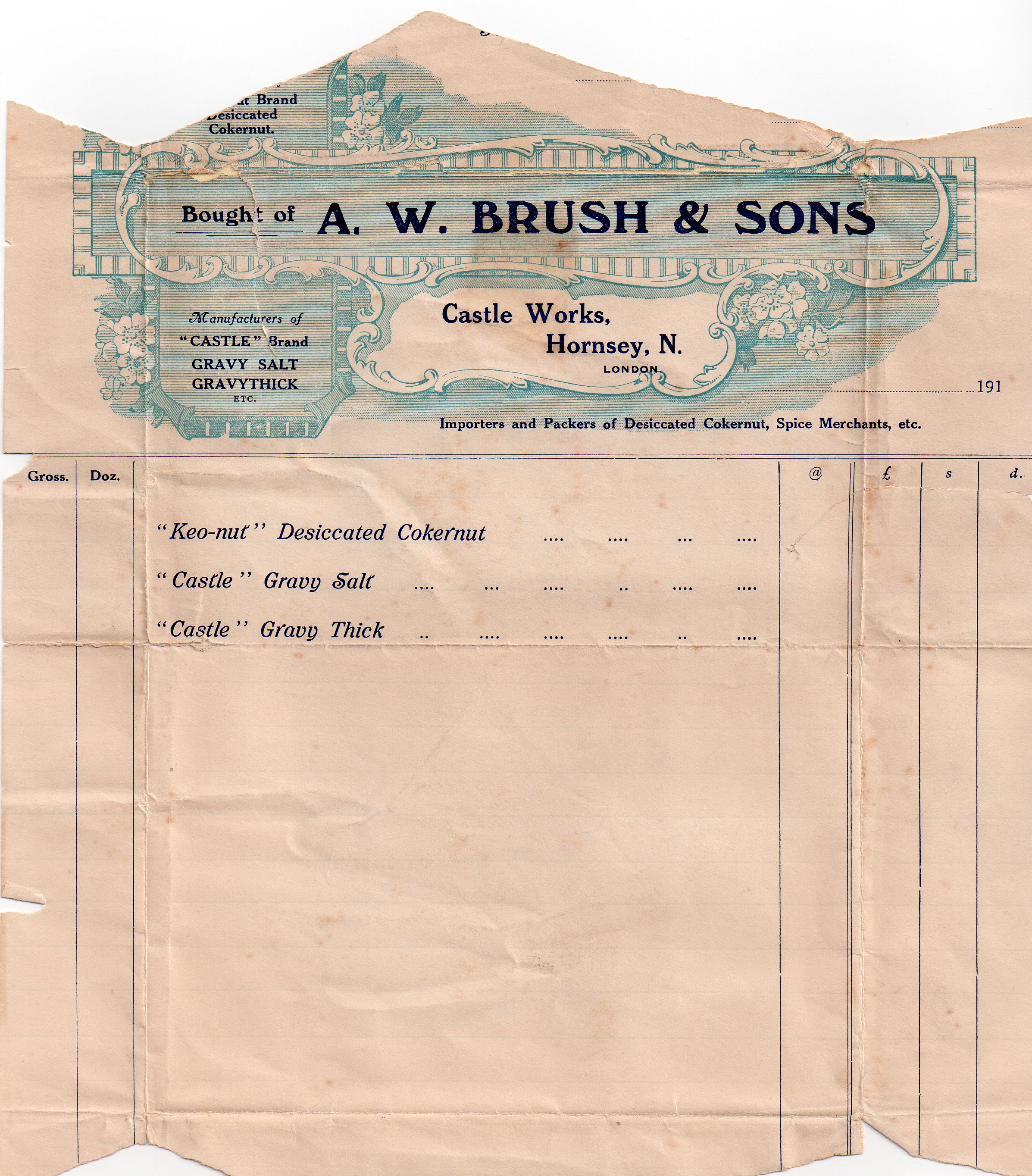 The only remaining evidence of the family business
In a surprise discovery the Hornsey Journal of Friday 9th June 1914 records that Mr Wesley Brush was the referee of a football match between the Hornsey Wesleyan FC second team and Claude Eliot's Lads Club. HWFC lost 3-0. Involvement in football did not part of dad's or my inheritance!
"The family was very much concerned with Middle Lane Methodist Church, [Arthur Wesley] being a Local Preacher(8), an officer in the Boys' Life Brigade (which later became part of the Boys' Brigade) and a teacher in the Sunday School. At one time he considered emigrating to Canada to become a minister of the church but decided to stay in England. (Remember that in those days travelling to Canada meant a long sea voyage - there was no air service then)."
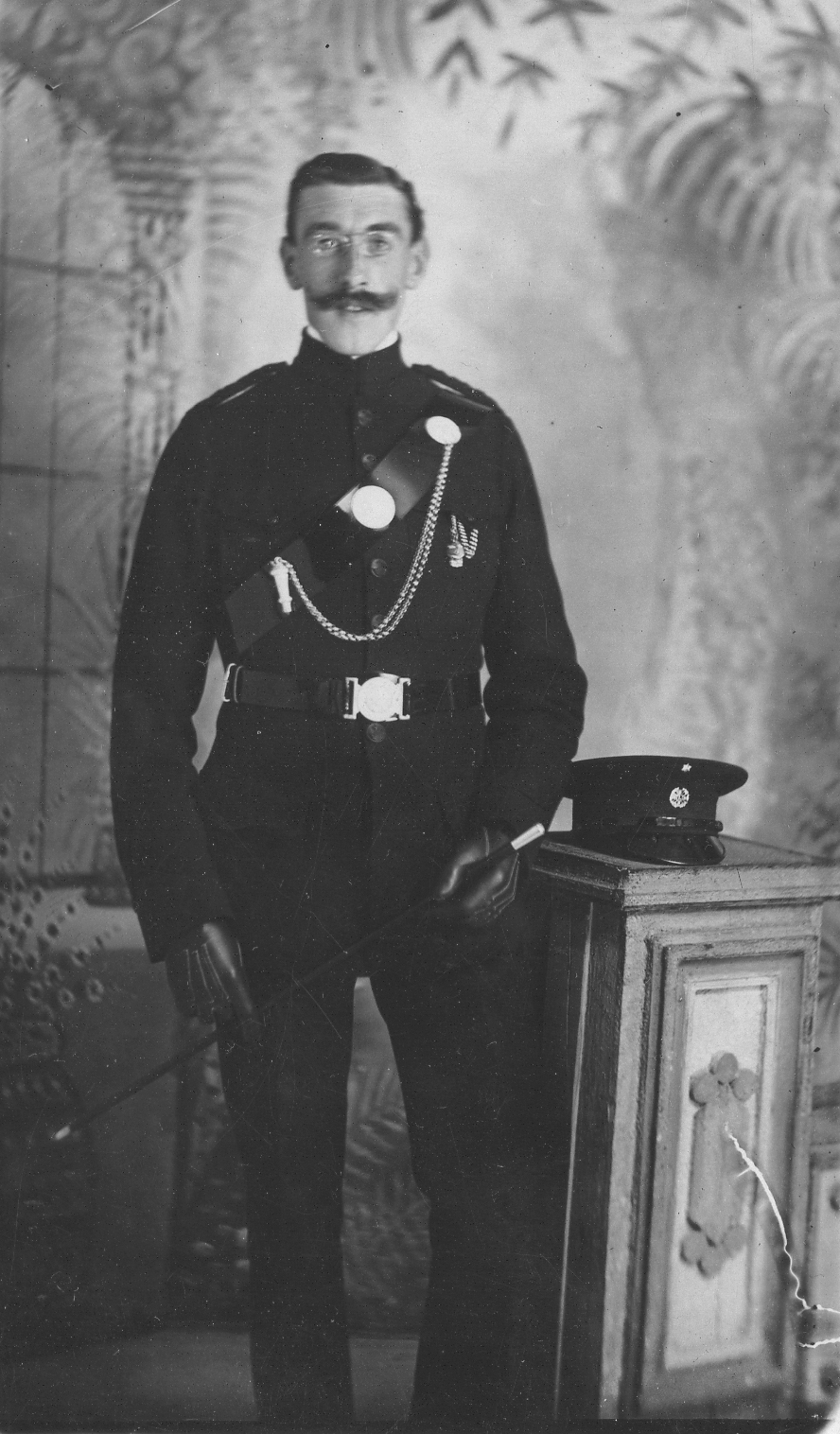 Arthur Wesley in the uniform of an officer of the Boys Life Brigade. A glimpse of his character can be seen from his message on the back of the uniformed photo, in which he variously refers to himself as Billy Muggins, Herr Von Frightenum and Dr Bunkum, signing off as "Wes".
"He was at a Boys' Life Brigade camp under canvas in 1914 when a telegram arrived from the War Office asking for the return of the tents - they were wanted for the British Expeditionary Force in France. My father and his brothers joined the army, Wesley in the Royal Army Medical Corps , George and Stanley in line regiments."
 Arthur Wesley, Herbert Stanley and George Douglas
standing behind
Emily, Arthur Wallis and Elsie Louise.
The sergeant's stripes on George's arm and the fact that Arthur has not yet got his corporal's stripes may help us date this picture.
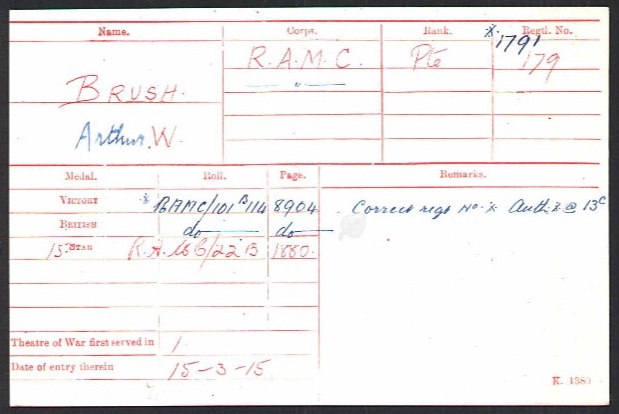
His medals index card (illustrated below) shows that Wesley enlisted on 1 September 1914. Britain had declared war only on 4 August 1914, upon Germany invading Belgium, so he was an early entrant. At the start of the war the Army was a volunteer one; conscription only came much later. The Imperial War Museum site records that "after the outbreak of war ...., Britain recruited a huge volunteer citizens' army. In just eight weeks, over three-quarters of a million men in Britain had joined up... recruiting offices were besieged by volunteers....The Army was unprepared for the stampede of volunteers wanting to fight, and men were often rushed through the official process for joining up."
How and why he came to be in the RAMC is not known. Given the strong Methodist links this may have been a deliberate choice but as a volunteer he clearly did not do so as a Conscientious Objector. There is an interesting discussion of this topic in the website 'men who said no' which asserts that volunteers could choose to enlist in a non-combatant unit such as the RAMC.
From somewhere, I have in my mind that his RAMC service was in the 6th London Field Ambulance, but I cannot now find the source for this. The record cards we have do refer to his unit beng 'RAMC TF' which I think refers to Territorial Forces - of which 6LFA was certainly part. The various numbers quoted on the medals and pensions documents are not clear. His reg or regtl number is given both as 1791 & 538206 , Repeated searches suggest that his service record is not available - some two thirds of such records were lost in a fire in WW2.
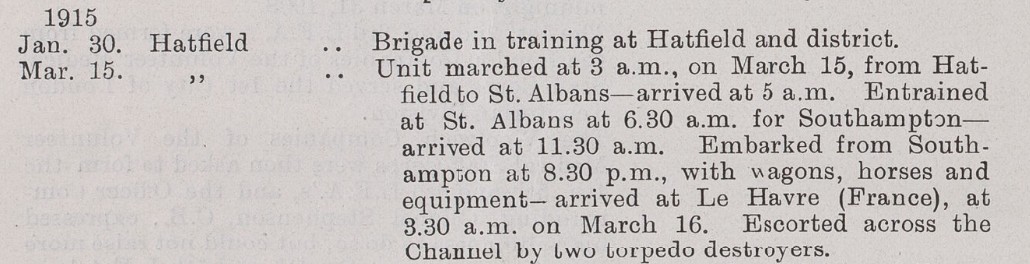
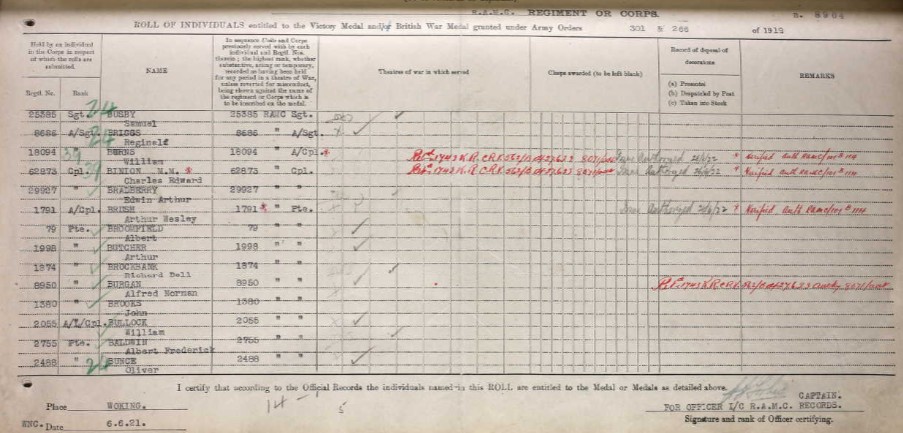
We can see from the Medals roll, below, that he served overseas. His Medal Roll Index card shows that he went to France on 15 March 1915.
 l
l
This is consistent with him having served with the 6th London Field Ambulance - as shown in "A Brief Record of the 6th London Field Ambulance (47th London Division) during the war".It is far from brief; quite a detailed record of what the 6th London Field Ambulance did and where they served. It draws on the war diary of the unit and othe sources.
 l
l
The next, studio, photo is clearly meant to represent the ruins of Flanders.
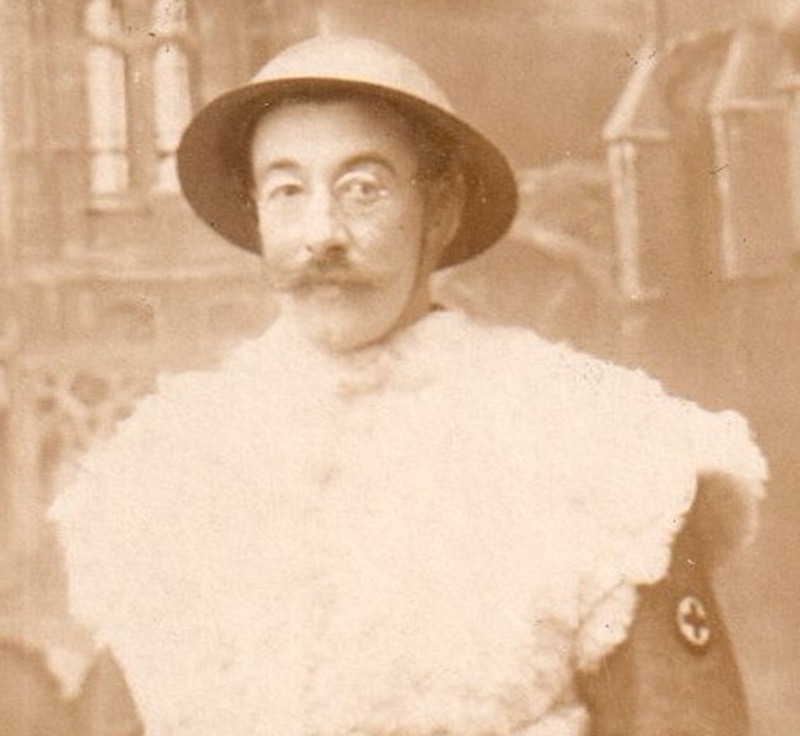 A dramatic background, and contrasting carpet, in a studio shot! It seems that sheepskin (or goatskin) coats or jerkins were first issued to troops in the 1914/15 winter ( before the ^LFA went to France) and there is a fascinating discussion about them in an online great war forum. The example Arthur is wearing looks suspiciously clean though.
 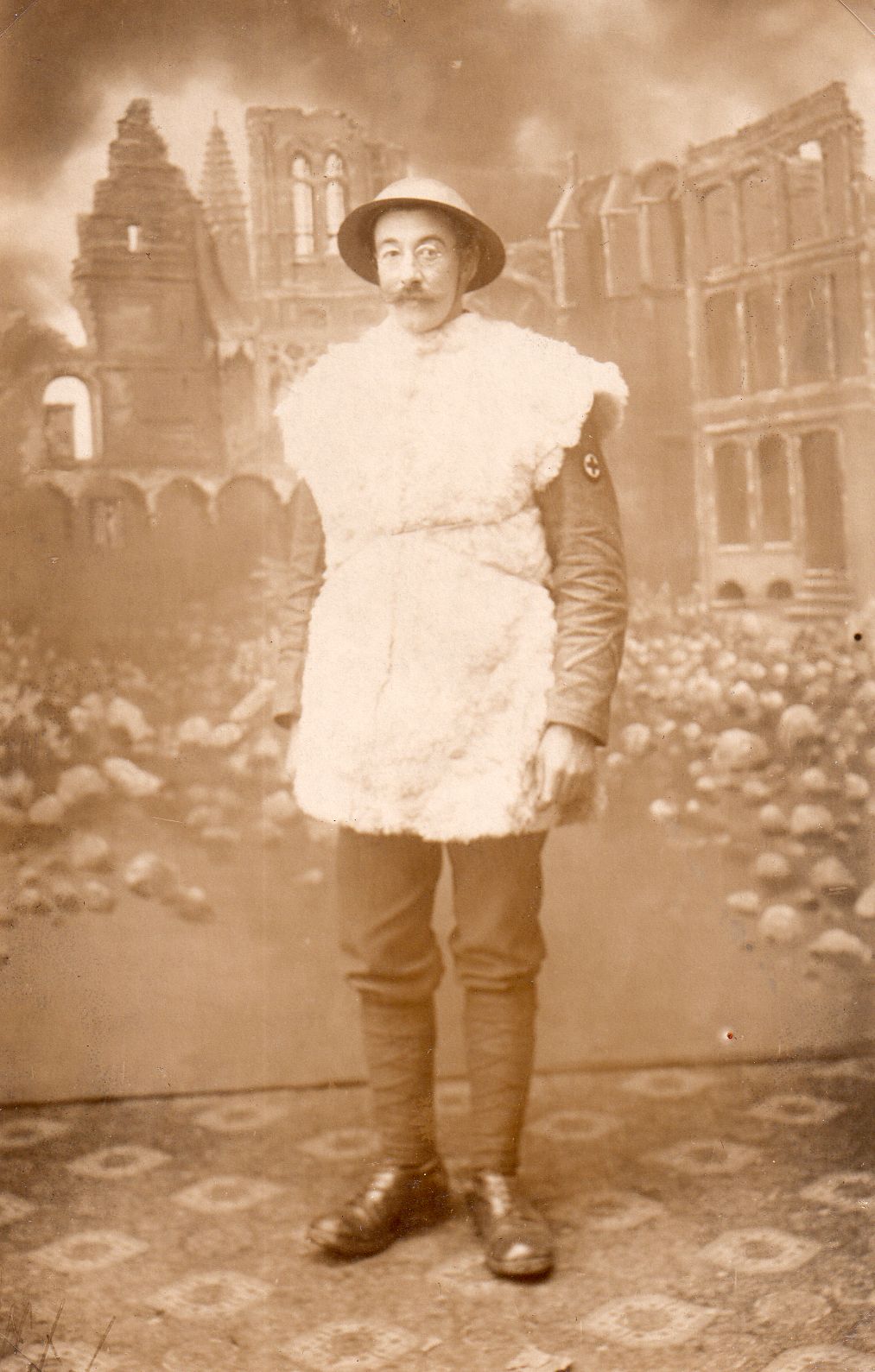 On one of the online discussion groups I have seen two other photos of other soldiers in front of the very same backdrop but with no date. The tin helmet was approved in September 1915 but only became standard issue in early 1916..
At some point he is made up to acting Corporal. The photo below shows him with his stripes.
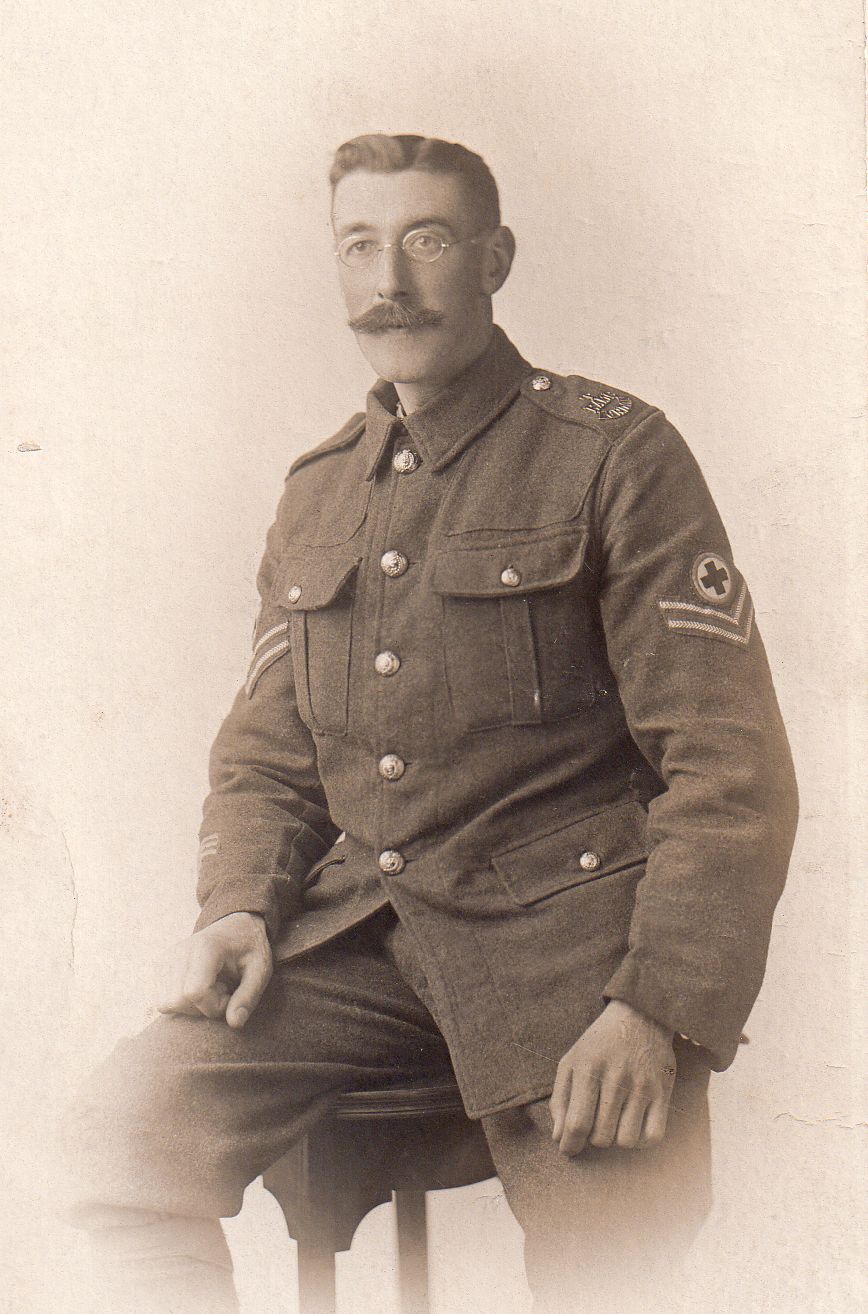 After he had become a Corporal
From the roll of individals entitled to Medals, shown below, it seems that he was a Private while in a 'Theatre of War' and became an Acting Corporal after that.
At some point while a Corporal he was in H company and later in Cp company at Colchester. This insignificant piece of detail is included as an illustration of how frustrating this process can be. The details were written by Wesley in the front cover of a book "Idle Thoughts" by Jerome K Jerome ( the man who wrote "Three Men in a Boat"). My father still had this book late in his life and transcribed the information onto a scrap of paper. Great, except that his handwriting had by then deteriorated to the point where it is parts unreadable. Where Wesley wrote his unit might read RAMC 5 - which might indicate something other than the 6th LFA?
 As FWB writes "Where does this fit in army career of AWB?"
Probably after his unit's return from France and shorty before his discharge.
His medals index card shows that he was discharged on 9 August 1919.
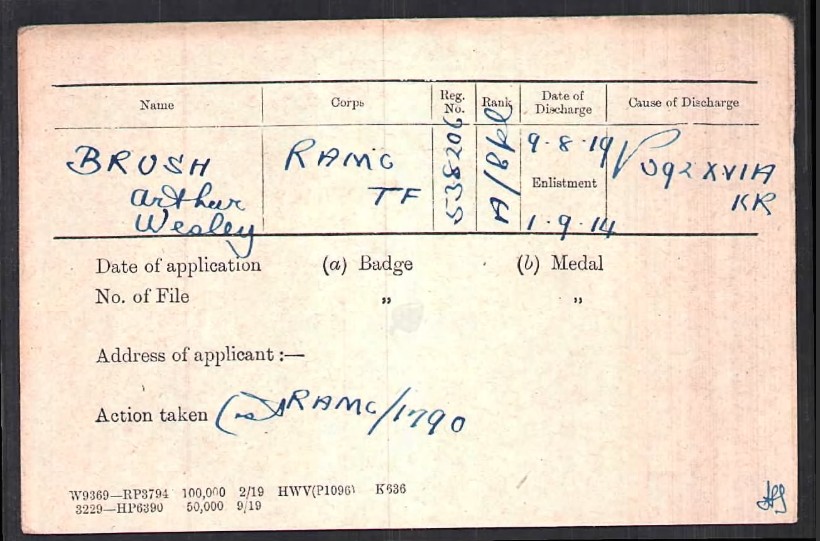


The cause of discharge on that card seems to be given as V092 XVIa KR but on the medals roll it is shown as 392 XVIa - a code from para 392 of the Kings Regulations 1912 meaning discharged as “Surplus to military requirements (having suffered impairment since entry into the service)â€
"[Arthur Wesley] never said very much about his service in France and Flanders but after his death in 1946 I found his discharge certificate which said that he had "served with honour and was disabled".
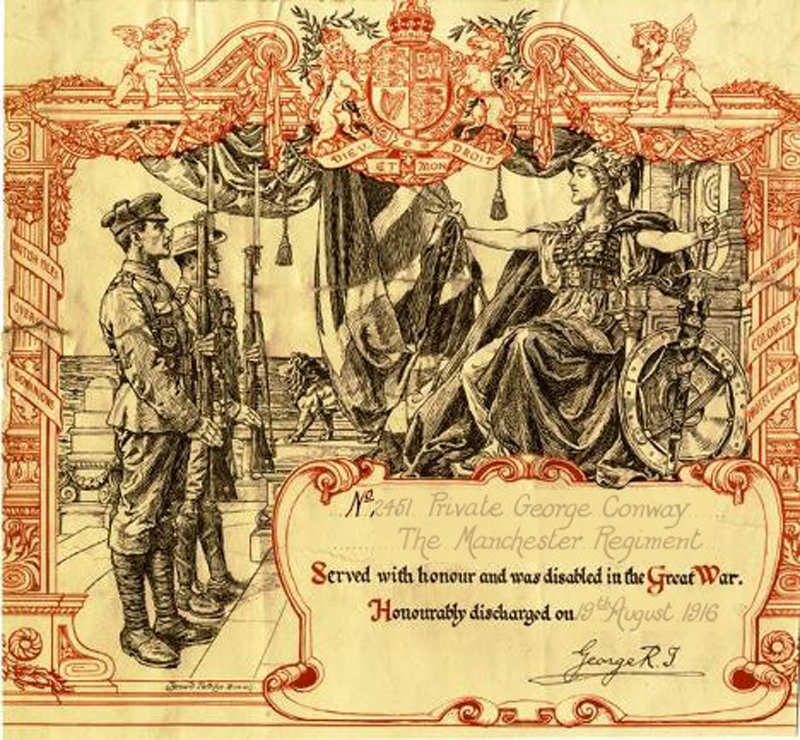 This is the form of certificate (known as 'The King's Certificate') he would have received in view of his XVIa discharge, but I have not been able to find the original that dad referred to.
"I believe his heart was affected by his service, a disability not visible to outsiders. He was sent to the Rectory at Berkswell in Warwickshire which was being used as a convalescent hospital for returning soldiers. One Sunday he went to the service at the Wesleyan Methodist Church at Balsall Common and was invited to lunch at the Elsons' farm - it was there that he met my mother" [Laura Nellie WEBB]. Laura and her WEBB family is the subject of section 33.D.T
At the 1921 census Arthur Wesley is not listed as back home with his parents - though it seems likely that it was still his normal place of residence. After a lot of searching I eventually found him in North Lancashire. He is listed on the census day/night as a "visitor" at Abbott Hall, Wesley Guild Holiday Centre, Grange over Sands - a seaside resort in the very north of Lancashire, just south of the Lake District. It was the responsibility of the manager of a hotel etc to fill in the return. It does not look to me as if he was on holiday there. Two schedules were completed for Abbott Hall. The first schedule contains the Manageress and 63 people listed as boarders (later corrected by the enumerator to 'visitor' ). The second schedule contains mostly employees listed as 'helper' plus a few more boarders. And right at the end of the list, after all the staff, - the 84th named person, is Arthur Wesley uniquely listed by the Manager as a 'Visitor'. It seems clear he was there in a capacity different from all the the other guest boarders but we have no idea why. Maybe some sort of inspection as a member of the Wesley Guild?
In the census form his personal occupation is listed as 'Sales promoter', his employment as 'sales' and his place of work as 'London & District' - which is not quite the level of detail that the census instructions expected to be put in those columns. Whether he was at this point a sales promoter for his father's grocery products or whether he had begun working for a bigger firm is not known. But the census record does still show Arthur Wallis as an employer - of someone. His business is described as "Wholesale Sundryman Spices, Baking Powder etc ". His workplace is "at home".
My father's text about Arthur's return from the war says : "However, all was not well. The grocery business which he had been expecting to return to was no longer there." This is not completly consistent with the census. Probably because of undue reliance on imported goods which could not be obtained in wartime there was no assured future and my father would have to seek employment somewhere else. This was just at the time when the labour market was swamped by multitudes of ex-service men. I understand that my father was employed as a representative (the term then was 'commercial traveller') by several different firms(8) and then eventually worked for a food firm called 'Bestoval' from the late twenties until the end of his life. The area he was responsible for was a large part of North and North-West London and for most of the time this was covered on foot, in buses and trams and in the Underground. He always dressed formally, with wing collar and bowler hat when 'at work' and always wore boots. He must have walked many hundreds of miles in the course of his work. "
"[Arthur and Laura] were married in the Chapel at Balsall Common on the twelfth of April 1922, Fred Elson signing as the Authorised Person to register marriages and Mary Elson signing as one of the witnesses. Wesley and Laura went to live at 32, Melbourne Avenue, Palmers Green..."
.
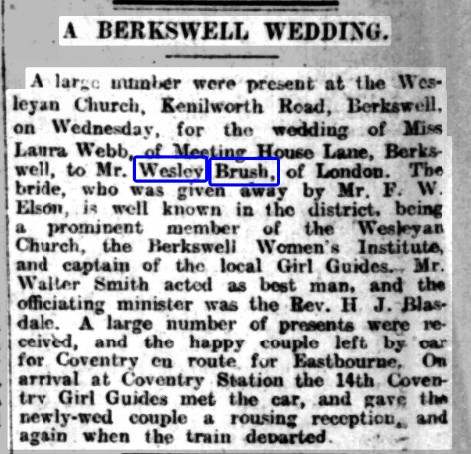 As reported in the Coventry Herald of 14 &15 April 1922. I never knew she had been a Girl Guide Captain.
The Spring 1922 electoral roll shows Arthur Wesley to be living at 32 Melbourne Avenue - without Laura being listed, it presumably having been prepared before their April marriage. The house that would be their home untl his death and her later move to Radlett.
They had two children; my father Fred Wallis BRUSH and his younger brother David who was murdered while in service with the Palestine Police Force. Their story, and menories of life at Melbourne Avenue, is contained in my father's memoirs beginning at Section 2.
"When the war started in 1939 my father said "We shall all come through the war safely". He was absolutely certain of this - and he was right. He died on the fourth of April 1946, some months after the war through which all four of us had come safely had ended. My mother stayed in Melbourne Avenue until the 'sixties' when she sold the house and came to live with us in Radlett."
Arthur's siblings
Arthur Wesley BRUSH had three siblings - Elsie Louise, George Douglas and Herbert Stanley
Elsie Louise
George Douglas
Uncle George, my great uncle, was born in 1899
At 1911, age 22 a Solicitor's Law Clerk, unmarried, living with hs parents and all 3 siblings.
George was the uncle with whom my father retained most contact and who he greatly respected. I have memories, albeit vague ones, of him visiting us in Radlett in the 1960s and 70s. Memories of a benevolent uncle.
Herbert Stanley
Herbert Stanley was my great uncle, though he had died
Next Sections: The story of Arthur's two sons is contained in the memoirs of eldest son Fred Wallis BRUSH. The story of Arthur's siblings is in Section 29.G